Thursday, July 28, 2011

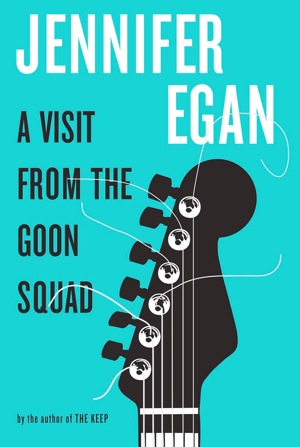
The only negative review of "A Visit From The Goon Squad" ever written

At first, I thought my title was hyperbolic. (Yes, Egan won the Pulitzer and the National Book Critics Circle Award, and, yes, the first three pages of the paperback—as well as the back cover—are filled with praise from seemingly every publication of significance, but what else would you expect? Obviously, no one advertises their negative press.) Then I googled “negative reviews of a visit from the goon squad,” which somehow only turned up more adulation, including a breathless story from The Paris Review by a writer suffering from “Egan Fever.” The only dissenting opinion I could find (besides the one posted on wackymommy.org) came from a reviewer for The A.V. Club, who disparaged rock ‘n’ roll books as a genre before tepidly concluding that Goon Squad is good but not great.

So let me begin by stating that I disagree with everything that’s been written about Egan, even by The A.V. Club—not only is Goon Squad not great, it’s not even good. The novel presents us with a string of flat characters based on clichéd types (a rich, middle aged record executive who feels like a sellout; a woman who steals because she has yet to deal with her traumatic past; a teenage girl who thinks it’s cool to party with an older man, then looks back on her life with regret).

The lack of character development is a direct result of the novel’s gimmicky structure; gimmicky because rather than providing multiple perspectives on the central characters—how do the sections about Dolly or Jules Jones enhance or complicate our understanding of Sasha and Bennie, for example?—or exploring a theme that can only be understood through the experiences of multiple characters—the primary themes of the novel are "compromise" and "regret," which each character experiences in the exact same way: everyone compromises on their dreams or ideals or artistic intentions; and everyone regrets that compromise—Goon Squad's structure serves only to build artificial momentum, pulling the reader along with the promise of a new character and style to discover in the next chapter.

Which brings us to the variations in style. There are subtle shifts between the narrative tone used for Sasha (ch. 1) and Bennie (ch. 2). Then there are the pronounced stylistic shifts into second person (ch. 10), absurdist imitation (ch. 9), idiomatic minimalism (ch. 3), first-person unreliable (ch. 6), and image rich travel writing (ch. 11). And then there are chapters that veer into the familiar territory of great fiction past: the over the top social satire of, say, Tom Wolfe (ch. 8); the Hemingway-esque African safari that reveals the unacknowledged cracks in a relationship (ch. 4); the quiet desperation of a husband and wife in the suburbs that evokes the likes of Cheever or Richard Yates (ch. 7). The critics have praised Egan’s virtuosity, but in reality the author has merely produced an amalgamation of the techniques and voices forged by her predecessors, which she then packages as innovative fiction. But there is nothing innovative about Goon Squad.

The only chapter that could rightfully be called inventive—the power point presentation—is a flop. This narrative device serves no purpose, diminishes the affect of the information it conveys, and stretches our willing suspension of disbelief (a twelve-year-old girl expresses the distress she feels about her family by creating a sophisticated presentation about the subtle tension between her mother, father, and brother? What did she do after that, create a flow chart to plan a conversation with her parents about buying tickets to a Justin Bieber concert?). By botching this chapter, Egan leaves us with a dissatisfying conclusion to the arc of Sasha, one of the two characters that hold everything together. Of course, the laughable final chapter—even the positive reviews have criticized Egan’s lazy, distopian take on the near future—compounds the dissatisfaction. Bennie, the other recurrent character, is equally forgotten in his final appearance in the novel. These clumsy final chapters only succeed in emphasizing that Goon Squad is not a grand epic about the destructive passage of time, but a series of low impact stories that rely on a loose (and ultimately meaningless) level of association to build a semblance of significance.

One final note: Egan’s decision to quote Proust in her epigraph not only signaled her intention to place Goon Squad in conversation with In Search of Lost Time, it also gave readers instruction on how she intended the novel to be approached. A bold move. Obviously, I think the association is ludicrous. For an excellent example of a Proustian reflection on the U.S. in the second half of the twentieth century, read Philip Roth’s American Pastoral (the 1998 Pulitzer Prize winner). Also, just read Swann’s Way.

Wednesday, July 27, 2011

Shape Shifting: Facing Fantasy in Miranda July’s No One Belongs Here More Than You


In Miranda July’s collection of short stories, No One Belongs Here More Than You, July’s protagonists live, almost always unsuccessfully, in imagined worlds that not only bleed into, but define, the social and personal interactions of their everyday lives. The result is a compelling, intimate, and experimental work that, much like a carnival’s room of funhouse mirrors, simultaneously entertains and mystifies the reader by both shape-shifting reality and reflecting a strange, distorted fantasy world in its place.

In each of her stories, July first exposes the fantasy worlds that the characters create. For instance, in “Mon Plaisir,” a female narrator introduces herself and her husband by depicting the imagined nature of their seemingly happy marriage.

"We are not people who buy instant cocoa powder, we do not make small talk, we do not buy Hallmark cards or believe in Hallmark rituals such as Valentine’s Day or weddings. In general, we try to stay away from things that are MEANINGLESS, and we favor things that are MEANINGFUL. Our top three favorite meaningful things are: Buddhism, eating right, and the internal landscape."

Likewise, in “The Shared Patio,” a woman imagines her and her neighbor’s shared patio as a place where she can find her identity and connect with others. In the “The Swim Team,” a woman, writing to her ex-boyfriend, details the swimming lessons she gives to elderly townspeople by dipping their faces in small, water-filled Tupperware laid out on the kitchen floor. In “Majesty,” a woman fantasizes about seducing Prince William at a pub near his school. And in “I Kiss a Door,” the narrator dreams of being the proverbially perfect Eleanor, of having Eleanor’s “perfect” father as her own.

However, July shows through these stories that, when fantasy and reality do finally meet, it often occurs in a sort of reverse-epiphanic moment, in which the main characters realize that being extraordinary is a myth like any other. Hopes and wild aspirations are replaced with a gravity, a humbleness, that makes July’s narratives more than simply zany and clever; her true depth as a writer emerges organically from her own outlandish plots in the same way as through her characters’: the more vivid the fictional world is, the harder it comes crashing down.

In “Mon Plaisir,” this shift takes place when the husband and wife are forced to create and maintain marriage as background actors in a movie. They realize, in this scene, that, like the movie couple they have created, their romance is just as fictional.

“Here we were again, eating together in silence.... Carl looked up, we stared across the table at each other. It was plain between us: we should not be together any longer. And cut.”

Additionally, in “Majesty,” when the narrator realizes she will never really meet Prince William, July gives us a haunting description of what, as in all the stories, has become of the narrator’s fantasy world.

“This pain, this dying, this is just normal. This is how life is. In fact, I realize, there never was an earthquake. Life is just this way, broken, and I am crazy to hope for something else.”

In addition to being unable to escape their imagined worlds, the characters also fail to communicate with each other across the fictional or real borders they have created. The most haunting story of the collection, “The Person,” revolves around an unnamed person who believes there is “a place where every person this person has ever known is waiting to hug this person and bring her into the fold of life” -- a place the narrator finds out, eventually, is unattainable.

“This person mourns the fact that she has ruined her chance to be loved by everyone... the weight of this tragedy seems to bear down upon this person’s chest. And it is a comforting weight, almost human in heft.”

Yet, one of July’s more controversial stories, “The Sister,” while revealing how sexual desire is often defined more by time and place, age, and desperation, than by the fantasies that bring us to those points, simultaneously gives the reader a glimmer -- be it a distorted one -- of hope. In this story, the main character, an elderly man seeking an imaginary younger sexual partner, finds that the realness of his sexuality is more important than accessing it through this “imagined” girl. The poetry of the final scene, in which two older men embark on a sexual relationship, undermines the assumed cultural taboo of the moment and shows how people actually can find ways to connect across the arbitrary moral and ethical (see: fictional) borders we set for ourselves.

“We slept. It was the sleep of one hundred years. And when we woke, it was still night, and Victor reached across me and turned on the lamp. We were two old men. Everything seemed ordinary, even overly ordinary. There was a fly in the room and it buzzed in a way that told us nothing amazing had ever happened in this place.”

Through each of the stories in No one Belongs Here More than You, Miranda July exposes, most importantly, that one who lives in a world of imagination has a reason for escaping the real world. Her characters, in confronting their fears and fantasies -- whether willingly or unwillingly -- also find a purity, a painful joy, in the act of being human. Reality, July seems to be proclaiming again and again, is more evocative than any fantasy can hope to be. This, I believe, is what truly connects all the stories and characters: by facing reality, they face themselves.

Friday, July 1, 2011

How Reading Lorrie Moore’s Self-Help Is Like Swimming in a Public Pool

I read at swimming pools. And because I’m borderline schizophrenic, I sometimes have trouble differentiating between fictional narratives and reality. Or maybe that’s just one of the many neuroses that accompanies writerhood. Potentially both are true. I read Lorrie Moore’s Self-Help poolside, and I watched the characters walk off the page and into swimming trunks and Spongebob floaties.

There was the wife watching her husband oogle the girl in too-small bikini.

There was the mother clipping a leash to her 13-year-old child.

There was the grandmother coating her leathery skin in coconut oil.

Mostly women, mostly in relationships, and mostly enacting self-destructive behaviors, these pool dwellers made it easy for me to draw swooping parallels. They laughed. The loved. They made ridiculous mistakes. In short, they lived. Like these people, Lorrie Moore’s characters are heartbreakingly honest.

You could work with the woman catering an affair with a married man.

You could babysit the 12-year-old girl exploiting her parents’ divorce for 7up.

You could have lunch with the mother, wife, and cancer victim who commits suicide.

But Lorrie Moore does more than offer you a glimpse into their lives. It’s not only voyeurism that makes these stories so satisfying. It’s not just that you watch their struggles and learn from their mistakes. It’s that you become these characters.

Since the dawn of the creative writing workshop, much has been said about the second-person narrative. Mostly in the form of, don’t do it. It’s gimmicky. It’s confrontational. You can’t pull it off. On the flip side, if you do pull it off, it creates urgency and snap, like a green bean begging to be eaten. The reader and story fuse.

At the swimming pool, as in these stories, I was not just watching the people around me. I was keenly aware of myself as part of the scene. I played a role in the narrative, and was, in fact, that girl in too-small bikini (it's probably time I buy a new one). I swam with them, sometimes barely keeping my head above water. I played with their children. I sunburned.

Lorrie Moore doesn’t offer a ten-step guide to beating depression or reveal the secret to driving your dream car. Instead, she gives us experiences that closely mimic her own. The characters aren’t helping themselves. More often than not they end up fired or dead or in a mental institution. But ironically, I still felt helped.

Because Lorrie Moore is an artist.

She can describe a bleeding wound, and we at once feel pity for the victim and awe for the scribe. We’re marveled by her ability to spin scabs into golden stories, and because we’re human too, we feel as though we may be capable of some such level of greatness.

Despite the strong emotional connection, the collection does indeed have some flaws. The drug-induced haze at the end of “Go Like This” falls flat. The men in the collection are intrusively one-dimensional. The stabbing in “To Fill” doesn’t behoove the character.

Yet, in many ways, these flaws make the collection even more endearing. Reading authors like Chekhov and Steinbeck can wear you down. No matter how hard I try, I will never write their stories. Our experiences are too dissimilar. Lorrie Moore is an accessible writer and watching her experiment on the page excites my imagination, much like watching a swimmer try a new dive. You may end up with a few sore spots, or even a head wound, but that doesn’t keep you from jumping off the diving board.

Tuesday, May 31, 2011

You will soon be surrounded by lovely ladies and laughter.

Coworker: Who are your favorite authors?
Me: Easy. Steinbeck, Chekhov, Vonnegut, Updike…
Coworker: Okay but who are your favorite living authors?
Me: Oh, no problem. Saunders, Eggers, Moffett, Bradbury…
Coworker: What about female authors?
Me: Oh snap. Well there’s Woolf, Wharton, Austen… errrrr… Wait, you mean current female authors? Jhumpa Lahiri… uhm… Ann Beattie… Uhhhh… J.K. Rowling?
Coworker: What about … no I guess vampire novels don’t count.
Me: Not unless they’re zombie vampires.

This was me, less than six months ago, attempting to wrangle some female authors from my wrinkled brain matter. I found myself sounding pretty sheepish, and by sheepish I mean curly, smelly, big-toothed. I’ve since taken a few more graduate courses at UNT in which female authors moonlighted, showing their faces once or twice a month before vanishing amongst the stars. Still, I’ve yet to read many stellar female authors, mostly due to my own gross incompetence. All that’s about to change.

I pestered Dr. Barbara Rodman until she agreed to guide me via a summer course on this very topic. I then bribed a few fellow classmates to join forces with me and hatch a plan to take over the world, which of course, will be secondary to our plan to read some lovely ladies of fiction. The preliminary list and tentative dates for meeting are below. If you’d like to join us, add some sweet comments to the post or just find me hanging out in outer space eating some delicious science nuggets.


Saturday 11 June Friday 17 June, 6pm - Lorrie Moore, Self-Help


Saturday 25 June - Jennifer Egan, A Visit from the Goon Squad


Saturday 9 July - Amanda Davis, Circling the Drain


Saturday 23 July - Kelly Link, Stranger Things Happen

Meetings at Banter – high noon.

Current participants include: Laura Miller, Adam Kullberg, Hillary Stringer, Matt Davis, Zach VandeZande, and Zach Coleman. Stay tuned for meaty posts chronicling the mind children of our meetings.

Friday, May 20, 2011

My year in the rough

Well, the end is here.  Perhaps, if billboards are to be believed, the end of all things.  The good news about going to grad school in Texas is you’re never too far from a gun show, so a couple of us are popping over to Frisco tomorrow morning to see about equipping ourselves for whatever may come.  I am thinking of something semi-auto with some kind of bitchin’ under-barrel grenade launcher.  Gotta spend that scholarship money on something. 

Mostly, though, I’m concerned about stepping out of the job of assistant fiction editor and into the job of production editor.  Today I took home the last of the fiction submissions and finished up paring down the stack of second reads to something manageable for Miro and Barb.  My good friend Matt Davis is taking over, so I’m not really worried (in fact, I’m sure he’ll do a much better job).  The talented and charming Laura Miller has already taken over the blogging, so I’m not really worried there, either (in fact, I’m sure she’ll do a much better job, and I’ll still be doing a little piece here and there).  I’m a little worried about my new job, which basically consists of making sure the issue exists twice a year.  That I’m able to gain that kind of trust from smart people seems like silliness.  Time will tell.

I’m going to miss getting to read all the stories we get, even the bad or ridiculous ones.  I’m going to miss finding those gems and getting to shepherd them into print.  I’m going to miss seeming a little haggard and weighed-down all the time (having to read a few dozen submissions a week is a great excuse for why your grading isn’t finished).  I’m also going to miss, in a small, weird way, the heartbreak of knowing that a story isn’t quite enough, that the writer on the other end of my rejection letter is a lot like me, and that even though I wasn’t able to do what they wanted me to do, we still share the same doubts, fears, and dreams.  Maybe it’s not a real or profound connection we share, and maybe I’m just kidding myself to think that we’re all part of a community here, but being on this side of the fence has given me a new perspective on how important storytelling is.    

So.  That’s that.


Tuesday, May 17, 2011

Booty Calls, Stiffed Waitresses, and 33 Blackbirds – Final ALR Reading of Spring

The booty don’t quit, but the semester do. We had our last ALR-sponsored reading of the spring semester on Friday the 13th – despite our collective friggatriskaidekaphobia, the microphones behaved sublimely and the axe-wielders kept their distance. Check out photos and excerpts below, and thanks to the ALR staff for the raucous good times!


Poetry by Nate Logan
"Booty Call Sonnet #14"

How much booty is too much booty?
Philosophers debating this question
say the unexamined booty is not
worth tapping. Poets either get
no booty, or say booty is a metaphor
for a beautiful man or woman
who has zero interest in poets.
In a world where booty, etc.
Can we know booty w/out its opposite, etc.
A good booty is hard to find, etc.
I'm looking for a feather-haired woman
with a knowledge of Chat Roulette.
Even on the Internet I'm sure--
the booty, it don't stop girl.


Fiction by Jessica Tomblin
from The Hostess, "The Painter" chapter

The man smiled at her as if he had a secret, and walked out the front door. Kate ran back to the table and picked up the black checkbook from it first, in order to begin busing and cleaning it for the next couple. As she lifted the book toward her, something fell out. At first she thought it was the check, but then she saw the tent of green. Lainey watched the color go out of Kate’s face, and Kate didn’t have much color to begin with; her white blond hair, in this moment, made her look somewhat like an albino. She threw the book back on the table and walked toward the door with a force that made her appear ghost-like, as if she were floating along at a rapid pace across the concrete floors toward the sidewalk. She held the door open with one arm so that the couple sitting next to the entrance, in the place we called the nook, could clearly see her.

The man, still on the street and walking steadily towards the maroon-colored Lincoln parked at the end of the block, turned with a slight jump at the sound of Kate’s voice.

“Excuse me, is there a problem?” She yelled after him.

“He stood there speechless for a moment before responding by shaking his head side to side as if to indicate that, no there was no problem, and then, not being able to help himself, felt the sides of his mouth turn up slightly on each side so that he was now silently standing there smirking at this ghostly figure standing in the door way.

“A dollar?” she said with no inflection so it sounded more a statement than a question, and so, the man stood again in silence until Kate grew tired of their staring contest and realizing the man had not, as she had hoped in the back of her mind, accidentally forgotten a bill or placed a dollar down, confusing it for a twenty, or even a ten, but had purposefully left her only the dollar tip, on his ninety-dollar tab.

Kate slammed the door and walked back to the table where the dollar lay on the floor beside the chair, still pushed out from where the man had been sitting. She picked it up and headed for the back bar, where Rocky sat drinking Jack and Cokes, oblivious to the scene that has just occurred at the front of house.

“This" she said, "is bullshit."


Poetry by Chris Beard
from "Love Abstract with Flood and Secrets"

There are thirty three holes in the sky
flying west, thirty three blackbirds
I see through to the source of rain,
and she wants birds to just be birds,
the sky to remain intact,
a pocket sealed with sun.

There are twenty five jars
where she keeps my hair,
where the curls wrap around
the bending light forever.

There are numberless hours spent damaging
the asphalt, our whole lives lived in a car,
enduring summer’s drag, drinking
like it is medicine to cure our heavy blood.

There are three years of storms back home
waited out in the basement with a bucket and oar,
water filling the window wells as we pretended to sleep
through the swell, burst, and flood, the disaster growing beneath us
as we floated up through the swampy mud.

Monday, May 2, 2011

ALR Reading Series

Yet another successful graduate-student reading at Jupiter House. Despite the lack of electronic voice-magnifying machinery (otherwise known as a microphone), our readers expertly delivered stimulating stories and poems that captured the attention of even the non-students in attendance. Check out excerpts below, and stay tuned for details on our next (and final) reading of the semester. 


"Hibernation" by Adam Kullberg

“You see what I mean? Just look at this thing,” his father said, kneeling down onto one knee beside it. He stroked the beast’s large, bowling-ball sized head as if the bear was some pet he had picked up the day before. The bear’s paws were as big as the boy’s lower back.

“Where did it come from?” the boy asked.

“Ranger found it a few years back, up near a campground. Biggest one they’ve ever seen around here, I hear.”

The boy leaned down and put a hand into the bear’s mouth, feeling the sharp, gleaming teeth with the ends of his fingertips. They felt warm to the touch. “How did they kill it?” the boy asked.

His father laughed and shook his head. “Kill it? No. This one died of starvation probably, maybe ate something it shouldn’t have. Rangers aren’t allowed to kill anything. Well, unless it’s in self-defense, of course.” He turned to the boy. “But the main rule of being a ranger is you protect the park. You defend it if you have to, you keep it clean, you make sure that no one hurts it. Like it were your child.”

The boy worked his fingers over the bear’s paws, comparing them to his own narrow, short fingers. He had never thought of nature as defenseless before, as something that needed helping. “Is that what you do then?” he asked, “defend it?”

“Of course. With my life, if I have to,” his father said matter-of-factly, “That’s the ranger’s code.”

“Would you ever leave it, though? The park?” the boy asked.

He thought about this for while. “No. I don’t think so.” He said. He leaned down and ran his hand over the fur, and a glazed look, much like bear’s own glossy black stare, came over his face. “It’s your duty to stay.”


"Toadkill" by Karen Kadura

The enemy oozed from the flowerpot and landed with a slick plop, quivering there like Jell-O and still wet from his recent watering. He was a dull, unremarkable grayish-green, and he lay unmoving on the sparse grass, smooth and glistening and immense. He must have been at least the size of both my father's fists together, and overweight besides. Although I knew one wasn't supposed to name anything that one was soon to part with, in that moment I christened him Fatty.

Fatty had a mutinous gleam in the beady little eye that peered out at me from beneath folds of fat, ignoring the dogs as they barked and whined behind the fence. His unwillingness to move struck me as disrespectful, although it may have just been that he lacked the strength in his legs to move his considerable bulk. I wondered how he had even managed to get into the flowerpot in the first place, and as I was thinking this he looked straight at me and blinked, slowly. He was surely mocking me; he had even managed to land with his entire left side facing me--the perfect shot. He seemed lazy, almost uncaring, and his apathy towards the danger he was in angered me. It seemed that he was in control of the situation, and I hated him for that. I raised the gun. "Where should I aim?" I asked Dad.


Poetry by Aubree Blomgren

from "How it Was, and Was Not"

You plus me was hardly larger than you without me, which made it easy for us to share the sleeping bag. / It was musty, / heavy, thick, big enough to hold a lumber jack and his ax. Its fabric was a forest of wild pheasants / in all stages of flight. / Printed to excite and to prepare the young men for sleep, so dreams become a hunt and a hunter / satisfying the instinct / to take home what's shot from the sky. Funny, at first, how we laid as if we'd been shot, and stacked, / in a hunter's bag, / one on top of the other. How I looked from the zipper to the quail, still alive in the quilted sky, / and didn't know / that the boy's sleeping bag tells him what life wants from him. 


Our awe-struck audience. 

Sunday, May 1, 2011

American Literary Review, Reviewed

This is solid, satisfying reading from accomplished and serious writers and artists cleverly attuned to the world of ideas, emotions, and rich imagery.
 Read the full review here.

Thursday, March 24, 2011

What's in a Nathan?

In one of the posts on the Vouched blog under the label “Awful Interviews,” Christopher Newgent asks poet Nate Pritts, “Should I call you Nate or Nathan? Sometimes I introduce myself as Christopher and people call me Chris, and I punch their mouths. I have hard punches.” What follows is an enlightening and extensive answer, most of which I will quote:

My given name is Nathan & when I first started writing poems & stories, I was calling myself Nathan. However, no one called me Nathan in real life – everyone called me Nate, everyone has always called me Nate [… but] the name “Nathan” seemed like it had the right center of gravity, the proper level of careful diction & studious energy. Nathan Pritts wrote poems about the moon, or about deer running through field grass. […] Poems were things that guys named Nathan wrote in their barn or somewhere out on the far reaches of their property while contemplating the majesty of a spotted owl.

But I started to have a sense that it was really difficult to write a poem about a spotted owl if, in fact, you had never seen a spotted owl.

So I started writing poems that were more about me – a guy named Nate […] I started to understand that a poem was a dynamic system that depended on a connection to the vital & coursing elements of my own actual life as it had been lived & as I was currently living it. So Nathan Pritts retired – from writing poems, for sure, & mostly retired from life as well. He’s lying in a hammock on William Duffy’s farm, very happy & smug & knowing & soulful. Nate Pritts is still alive & writing poems that reflect his complete & utter confusion about being alive in language that struggles to pin down exact & emotional statements about a world that is constantly forcing him to THINK rather than FEEL.

So: call me Nate.

Like Nate, my given name is Nathan. But most everyone also calls me Nate. I introduce myself as Nate, Nate is the name I type on academic papers, my Facebook page says Nate, and a popular shirt reads, “I Hate Nate Logan!” Nate is everywhere for me.

But when my poems go out into the world though, I use Nathan. When I've been lucky enough to be introduced at readings, I write Nathan in the bio. When women get mad at me, they say Nathan. What is the difference between Nate and Nathan?

On some level, I agree with Nate's explanation: “'Nathan' seemed like it had the right center of gravity, the proper level of careful diction & studious energy.” Though I have never written poems about the moon or wildlife running through grass, “Nathan” fits like a cozy glove. “Nate” is missing something...something intangible that I can't put my finger on. Do I think that Nate sounds less respectable or reputable? No, not at all. Does “Nate Logan” sound worse/better/about the same as “Nathan Logan?” I don't think it sounds worse, it just sounds different.

Some of Nate's concerns are wrapped up in my own, but at this point in my life, I am happy to keep Nathan around. I don't have anxiety about having to choose between Nathan and Nate, but it is a choice I make, which implies that there are some decisions being made based on criteria, conscious or unconscious. It doesn't seem that Nate had “anxiety” about this either, but based his choice of name on larger concerns.

The question of name is something that I'm going to continue to think about. Maybe I will have an answer as insightful as Nate's someday. But until then, keep an eye open for the “Eight Nate's” or “Nine Nate's” reading. That's where you'll find me, cheering from the Nathan bench.

Wednesday, March 2, 2011

Review: Christine Sneed's Portraits of a Few of The People I've Made Cry

At the end of last semester, Miro walked into the ALR office and asked me if I had time to review Christine Sneed’s Portraits of a Few of the People I’ve Made Cry, and I said yes, and I read it that weekend and quite enjoyed it, and then, somewhere between revising stories of my own, getting the ALR issue finalized and proofing it, getting my grading done, and then heading off to the tragicomedy that was my Christmas break… well, let’s just say I’m a terrible human being who can’t be trusted.


So when Miro asked me again to review the book this past week, I of course felt like an ass, which is probably not the feeling Sneed would want her book to prompt in someone who liked it a good deal, but here we are.  The book itself, which won the Grace Paley Prize and was published last year, is now a finalist for the LA Times First Fiction Award, and for good reason.  The ten stories in this volume have a special knack for getting at the personal politics underpinning adult relationships, particularly ones in which there’s some kind of authority gap (dramatic age differences between lovers factor into several of the stories).

The opener, “Quality of Life,” is one of the more harrowing pieces, a sharp thesis statement of a story that hinges on the kind of personal compromise that happens when a powerful man decides that a woman belongs to him.  It’s a story that’s squelching and awful in the best way (think Don Delillo when he starts being mean to his characters), and serves as a cautionary tale to set the tone and remind us of the tension inherent in the stories to come, even as they play out without the kind of clear sense of danger that “Quality of Life” has.  Here, Sneed demonstrates a knack for revealing her characters without letting us know she’s revealing them—the mysterious Mr. Fulger makes a point of sticking around to see a would-be thief get his due, saying “I’m sure this isn’t his first offense.  He knew what he was doing.  But obviously so did I.”  A statement like this puts a character into sharp focus, and Sneed makes the most of moments like this one.

The writing is pretty keen throughout, but I’d like to single out the beginning paragraph of “Twelve + Twelve” as one of my favorites of my past year of reading, a bitter little firecracker screed that put me right where I needed to be in the story:

Someone in the alley three stories below my window was calling out to someone else and what he was saying was not very nice.  Maybe he did it because we were all stuck in an ugly, listless March, ice visible everywhere and clinging to our lawns like a dense gray scum.  We were exhausted and cynical under cloudy skies, our pants cuffs perpetually caked in grit and mud, our car tires spinning and spinning on snow-choked streets.  No one I knew was outside digging up the flower beds, and certainly no one was in the mood to offer spare coins to strangers distractedly ransacking their pockets for change to feed the meters.  Instead, people were talking heatedly into mobile phones or looking down at their feet as they trudged, these unloved husbands and crash-dieters and stubborn musicians and disbarred lawyers who all huddled in on themselves because among their other hardships, winter hadn’t yet ended and at this near-unendurable point, they just couldn’t look each other in the face.

There’s this great, desperate energy when Sneed gets cracking that I like a lot, and it runs throughout “Twelve + Twelve,” which was perhaps my favorite in the collection.

You’re So Different, concerning a famous director returning home to her high school reunion, is another standout.  So too is the title story.  I hesitate to say that these stories are all about people realizing their own powerlessness, because that would make it seem like Sneed’s characters don’t have agency (and let me tell you, they do), but they are about what we can’t control, what we have to give up, and how other people define us.  One of the frequent conversations we have about stories here at UNT is if the kind of stories you find in literary journals are flat, mechanical, or boring.  It’s a real danger, but it comes with a real reward, as the best “literary journal” fiction contains a truth you’re not going to find anywhere else, and Sneed’s book proves that point.

If the stories seem to go a little slack in the back half of the book, it’s only because of what’s come before.  The arrangement of a short story collection is always a dicey affair (I personally hold to the “crap sandwich” as the best approach, where the good stuff goes on the outsides), and maybe shuffling the deck a little would benefit the book; regardless, the ten stories in Portraits of a Few People I’ve Made Cry reveal a voice that we should be paying attention to.

What I'm saying is that I spend a lot of time as the assistant fiction editor sorting through the slush pile, and yeah, there are gems, but there's also a lot of chaff (and many, many mixed metaphors).  The rest of my time is spent plowing through Tolstoy or Carver or whichever other old hat established writer I haven't gotten around to before now.  So coming across a book like this, full of solidly-plotted, well-written stories by an up-and-comer with a clarity of vision that seems rarer and rarer in the contemporary short story… well, it's a nice feeling is all, and if I had my way Sneed's book wouldn't find its way back to Miro; instead, it would slide into a place on my shelf between George Saunders and John Steinbeck, not too far away from Lorrie Moore, Mary Gaitskill, and Alice Munro, deserving its place.