Showing posts with label ALR Summer Book Club. Show all posts

Friday, August 5, 2011

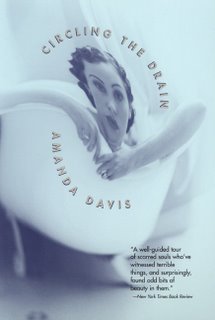
Ahhh-Choooo! Overspiced Stories in Amanda Davis’ Circling the Drain

I was on my lunch break, trolling leisurely through the McSweeney’s website, when I unearthed Amanda Davis’ short story “The Fat Ladies Floated in the Sky Like Balloons.” I spent the rest of the afternoon trying to unwrap my mind from those fat ladies. I couldn’t stop thinking about the story. I had to print a physical copy, fold it in half, and tuck it under my seat. I had to physically separate myself from the story so I could at least attempt to finish the day’s work.

Never had I encountered magical realism that left such an impression on me. I was awe-struck by the juxtaposition of imaginative qualities and harsh emotional realities. I craved more of the same intensity and ingenuity when I eagerly ordered Davis’ first (and only) collection of stories, Circling the Drain. What I found was a daring exploration of the conflict between logos and pathos. For the most part. Many of the 15 stories are short—between 1 and 6 pages. Some experiment with fable while others sparsely depict ordinary realities. Only three of the stories combine the supernatural with the natural, creating the immediacy and contrast that I initially found so appealing.

In Fat Ladies, Davis uses fantastic elements to exaggerate the positives and negatives of a failed relationship. The floating fat ladies, exploding flowerpots, and impaled pets represent logical and emotional reasons for ignoring Fred’s reappearance. Yet in the final scene, Eloise cannot bring herself to swing the hatchet a second time: “This probably isn’t such a great idea, I began in my head, but what I said was, Nice day.” The character’s self-awareness and vulnerability give the story a meaty backbone that anchors the fantastic elements and gives them their own weight.

The only other story that comes close to achieving this wonderful paradox of character is “Testimony.” We watch as a family unravels, as a brother cuts out his own tongue and a sister searches for the words that he can no longer speak. We see the brother prying out his own teeth; we see the sister combing the isles of a bookstore. The structure grounds the mystical elements, and in the end, Davis leaves us with a question about the nature of humanity, as she did with Fat Ladies, thrusting the story into its larger context.

While I believe the collection is meant to stand on three legs: “Testimony,” “Circling the Drain,” and “Faith or Tips for the Successful Young Lady,” only “Testimony” achieves the emotional resonance that the others attempt. Davis sometimes relies on shock value (arson, murder, attempted suicide) to propel her stories, and as the result, the characters come off as impulsive and incapable of adapting to the circumstances they have created. All three stories contain spirits, angels, or ghosts that illustrate the characters’ battles with the internal landscape. Each story is divided into numbered sections that skip around in time and space. Yet, rather than anchor the collection, they stand alone in a clump, while the others wriggle and streak in every possible direction.

As the collection’s legs straddle the line between fiction and reality, other stories cut the strings and go spiraling skyward. There’s the entertaining, five-page story about Billy Foo – a local chef who is fed his own ego, “Spice.” There’s “Chase,” the story of a woman who poisons her boyfriend’s magical blue horse. Wonderfully imaginative, simple, and fun, stories like these lift me out of the collection, which largely depicts gritty urban realities. They’re clowns at a funeral – they deserve their own confetti-filled backdrop.

Similarly, hyper-realistic flash-fiction pieces like “Fairy Tale” and “The Very Moment They’re About” refract the collection’s core. They send the reader spinning in a different direction – toward compressed moments in reality. The jarring contrast between these stories and the fantasy-based stories leaves the reader without a clear sense of Davis’ style and muddies the purpose of the collection as a whole.

Davis takes a bold approach. She mixes styles, genres, and themes. Her tales flop from fantasy to magical realism to just plain realism. We understand that her scope is far-reaching – that she’s capable of writing in a variety of genres. Unfortunately, we don’t come away from the collection with an understanding of the stories themselves. We’re pushed and pulled in so many directions that the characters and their stories get lost in the shuffle.

Typically, after an author’s first collection of short stories, we can say that she is a writer to watch. But for Davis, Circling the Drain and her first novel, Wonder When You’ll Miss Me, are all we’ll ever have. Amanda Davis died tragically in a plane crash in 2003, just prior to her book tour. I highly recommend reading her stories. They’ll set your imagination aglow, just as “Fat Ladies Floated in the Sky Like Balloons” did for me. But choose one at a time, and savor the flavor. As Billy Foo knows, if you combine all the spices at once, you may end up over-complicating what would otherwise be a breathtaking dish.

Tuesday, May 31, 2011

You will soon be surrounded by lovely ladies and laughter.

Coworker: Who are your favorite authors?
Me: Easy. Steinbeck, Chekhov, Vonnegut, Updike…
Coworker: Okay but who are your favorite living authors?
Me: Oh, no problem. Saunders, Eggers, Moffett, Bradbury…
Coworker: What about female authors?
Me: Oh snap. Well there’s Woolf, Wharton, Austen… errrrr… Wait, you mean current female authors? Jhumpa Lahiri… uhm… Ann Beattie… Uhhhh… J.K. Rowling?
Coworker: What about … no I guess vampire novels don’t count.
Me: Not unless they’re zombie vampires.

This was me, less than six months ago, attempting to wrangle some female authors from my wrinkled brain matter. I found myself sounding pretty sheepish, and by sheepish I mean curly, smelly, big-toothed. I’ve since taken a few more graduate courses at UNT in which female authors moonlighted, showing their faces once or twice a month before vanishing amongst the stars. Still, I’ve yet to read many stellar female authors, mostly due to my own gross incompetence. All that’s about to change.

I pestered Dr. Barbara Rodman until she agreed to guide me via a summer course on this very topic. I then bribed a few fellow classmates to join forces with me and hatch a plan to take over the world, which of course, will be secondary to our plan to read some lovely ladies of fiction. The preliminary list and tentative dates for meeting are below. If you’d like to join us, add some sweet comments to the post or just find me hanging out in outer space eating some delicious science nuggets.


Saturday 11 June Friday 17 June, 6pm - Lorrie Moore, Self-Help


Saturday 25 June - Jennifer Egan, A Visit from the Goon Squad


Saturday 9 July - Amanda Davis, Circling the Drain


Saturday 23 July - Kelly Link, Stranger Things Happen

Meetings at Banter – high noon.

Current participants include: Laura Miller, Adam Kullberg, Hillary Stringer, Matt Davis, Zach VandeZande, and Zach Coleman. Stay tuned for meaty posts chronicling the mind children of our meetings.

Thursday, June 17, 2010

ALR Summer Book Club: Raymond Carver's What We Talk About When We Talk About Love (both the original and final manuscripts)

Although Raymond Carver may compare to the “indie band that has become so popular and influential that it’s no longer cool” (see last week’s post), he still merits two weeks in the American Literary Review Blog spotlight. And why not? This indie band is popular because of talent. Carver did not lip-sync his way into undergraduate textbooks. He knows something about writing—something the rest of us should pay attention to. And so we are. Last week, we looked at Will You Please Be Quiet, Please? This week’s focus is What We Talk About When We Talk About Love (the final book and the manuscript version).

The same kinds of techniques that impressed Zach continue to impress me in this week’s reading. Carver uses minimalism and open-endings to draw in readers. As some of his titles demonstrate, his writing isn’t always the most straight-forward or concise. But it’s accurate and means exactly what Carver wants it to mean (let’s not get into literary theory . . . ). The reader knows exactly what Carver’s talking about and why (until it comes to some of the endings, of course). Carver presents only the necessary facts and does not spend much time describing the woman behind the check-out counter or the green shrub that grows next to the front door. He does nothing of the sort.

Instead, he makes statements such as “in this manner, the issue was decided” (303) from “Popular Mechanics.” This single line tells the reader that a baby dies by landing on a lit stove—a very unpleasant matter that does not require images of burning skin or terrorized screams. The reader can imagine pain and gruesome details well-enough without additional help. Everyone experiences pain, and everyone has the ability to cause pain or to make a mistake. These pains and mistakes become the topic for much of Carver’s writings. He chooses to hone in on the pivotal moments in peoples’ lives—the moments that start a new course. And, most of the time, these changes are not seen as positive from the characters’ points-of-view.

For instance, the story “Gazebo” centers on a husband’s affair that leads to the disintegration of his marriage. The narrator says that he and his wife “fouled” their lives and “were getting ready for a shake-up” (238) even though the husband claims to be the only person in error (along with the maid). The husband cheats, and the two begin to disregard all of their responsibilities and try to make the affair right or disappear. But this is not possible. The man’s actions begin an unstoppable course.

In “Sacks,” a father speaks to his son about how he goes for such a long time without “breaking any rules,” but suddenly cheats on his wife. Even he can’t explain the cause. In neither of these (and in most of) Carver’s stories, the narrators regret the “bad” decisions made. Carver does not celebrate these “rebellious” actions, but shows how all people are capable of acting out of character and that—sometimes—the consequences of said-mistakes change everything in a life. Carver defines those unavoidable human moments of life. Not all pain comes from mistakes, though, and shows up whether we “deserve” it or not. Topics of Carver’s stories also include childhood cancer, growing apart, and old age.

No matter the topic, though, Carver only includes details that matter (as stated earlier). Just as with Tobias Wolff, Carver’s stories challenge me to include only pertinent details (a kind of tricky thing to do). As Mr. Vande Zande pointed out last week, all of Carver’s minimalism and partiality to everyday heartbreaks solidify at the end of his stories. In the “Tell the Women We’re Going,” Carver describes the relationship of lifelong friends (Bill and Jerry) and the aspects of life they’ve shared (and that’s pretty much everything). But something changes at the end. The two men hit on two girls (their ages aren’t given) and the narrator believes that this is a kind of innocent event (as innocent as adultery can be).

Carver shocks the reader in the very last paragraph of the story: “He never knew what Jerry wanted. But it started and ended with a rock. Jerry used the same rock on both girls, first on the girl called Sharon and then on the one that was supposed to be Bill’s” (264). Bill and Jerry did not share this event and Bill is left trying to figure out how it all happened. And so is the reader. The events are clear, but their meaning is not—just as in real life. Meaning in life—and in stories—cannot be forced.

The open-ended stories that Carver uses to gently lead his reader to meaning tend to be stronger in the final version of What We Talk About When We Talk About Love? The final version of the manuscript includes a one more story and a different mix of the others. What strikes me most about the changes Carver made to the stories does involve details given and the endings (one the same in some instances). In “Why Don’t You Dance?,” the final version includes this description of the homeowner:

“The man came down the sidewalk with a sack from the market. He had sandwiches, beer, whiskey. He saw the car in the driveway and the girl on the bed. The saw the television set going and the boy on the couch” (225).

This version includes much less detail about the man than the original:

“Max came down the sidewalk with a sack from the market. He had sanwiches, beer, and whiskey. He had continued to drink through the afternoon and had reached a place where now the drinking seemed to begin to sober him. But there were gaps. He had stopped at the bar next to the market, had listened to a song on the jukebox, and somehow it had gotten dark before he recalled the things in his yard” (753).

Carver deleted much of the detail from the first draft of the story. This gives the reader much more independence to find out who Max is and why the furniture is in the yard. The original description makes Max out to be a desperate lonely man “drinking away his sorrows.” While this is still true in the second version, Carver leaves this information out, adding a bit more mystery to the story for the reader—causing the link between both the girl’s and Max’s desperation to be less apparent.

The original version of “Tell the Women We’re Going” includes much more detail—more unclear detail—than does the final version. Earlier, we looked at the concluding paragraph of the final version of this story. Carver quite bluntly inserts a scene where Jerry undoubtedly injures (or kills) two girls with a rock. The original version, though, is much more unclear:

“But Jerry was standing now in front of him, slung loosely in his clothes as though the bones had gone out of him. Bill felt the awful closeness of their two bodies, less than an arm’s length between. Then the head came down on Bill’s shoulder. He raised his hand, and as if the distance now separating them deserved at least this, he began to pat, to stroke the other while his own tears broke” (844).

To me, there seems to be some pronoun confusion here (maybe on purpose)? I am not sure whose bodies are close together . . . Bill’s and Jerry’s and Jerry’s and the girl’s? I am betting the second, but this is merely a guess. This ending also leaves much room for confusion regarding whom all is dead (both the girls or “just” one?) and who is patting whose head? Sometimes I am a dense reader, but I did not feel confused whenever I read the final draft of the story. Instead, I knew who killed who and the ramifications this cost—or what this signified in—Bill and Jerry’s relationship. Carver toned-down the details in order to clarify his main point so that the reader can connect the dots in the proper way. This is one kind of lesson writer’s should take away from Carver.

For the sake of length, I’ll leave it here. Do make sure to read the Selected Essays section of the collection. The essays shed light on Carver’s background and also his writing process. His essays alone deserve two or three blog spotlights.