Showing posts with label Contemporary American Literature. Show all posts

Friday, January 20, 2012

We Have a Love-Hate Relationship with Lists

This is the only time of the year that it's acceptable for us to shove our reading lists in your face without you saying: "how dare you. how dare you tell me what i should be reading. like i don't have lists and lists of my own, piling up like uneaten pancakes. don't you see how many delicious pancakes i have to eat already? get yours out of my face."

Well it's 2012 now, and its time to eat some new lists. Here's some books the ALR staff devoured last year:

Inferno by Eileen Myles - Caitlin Cowan

Owning It All by Bill Kittredge - Ryan Flanagan

The Kids Are All Right by the Welch siblings - Jessica Hindman

Either Way I'm Celebrating by Sommer Browning - Nate Logan

Horse, Flower, Bird by Kate Bernheimer - Kara Dorris

The People of Paper by Salvador Plascencia - Tim Boswell

Lord of Misrule by Jaimy Gordon - Hillary Stringer

The Facts by Philip Roth - Matt Davis


The View from the Seventh Layer by Kevin Brockmeier - Laura Miller

Tuesday, November 15, 2011

Dr. Fawzia Afzal-Khan on memoir


On Saturday, November 5th, Dr. Fawzia Afzal-Khan gave a reading and Q&A at UNT. Fawzia was in Denton to give a paper at UNT’s South Asia Peace Conference. She is a University Distinguished Professor of English and the Director of Women and Gender Studies at Montclair State University in New Jersey. She has published poetry, plays, and books of literary and cultural criticism. Her memoir Lahore with Love Growing up with Girlfriends, Pakistani-Style was originally published by Syracuse University Press in 2010, and received rave reviews from both magazines and notable individuals such as Nawal el Saadawi, Bapsi Sidhwa, Henry Louis Gates Jr., and Mandy Van Deven. Syracuse University Press dropped the book after a “character” threatened a lawsuit that proved inadmissible. But despite this attempted censorship—which Fawzia details on her website and in an appendix to the new edition of her book—her memoir remains in print with Insanity Ink Publications.

Fawzia’s memoir is the story of the past fifty years of Pakistan’s political, cultural, and social transformations. The book is both global and local, personal and political, and, as Carole Stone states in her introduction, it is “both a paean and rebuke to Pakistan, the country of Fawzia’s birth. It is a witness to violence against women, strictures of a patriarchal society, and narrow-minded religion, and dictorial government.” The Pakistan that Fawzia and her girlfriends inhabit is a country continually in flux, struggling to define itself in and against the increasingly homogenizing forces of globalization. The hopes, fears, triumphs, and shifting inter-relationships of this close group of female friends reveals, as Fawzia detailed in an interview, both “nostalgia for that vanished secular past and promise of Pakistan” as well as an acknowledgement of the reality of the country’s present. Yet Fawzia’s life as an international literary figure and activist diverges from the lives of her girlfriends who have remained in Pakistan, causing her to feel that she is constantly on “that rusty see-saw” remembered from childhood, a traveler both at home and abroad.

Fawzia is not the first writer to face controversy in telling the story of her life. Memoir is a genre often fraught with conflicting demands: to tell the truth, but to also acknowledge that memory can never be entirely truthful. To depict, then, these conflicting truths of memory in the most honest manner, but to also render the events of the past in a meaningful way. To give “reality” an unreal and artificial narrative structure necessarily means foregrounding some truths and letting others fall by the wayside.

In the Q&A after the lively reading which included singing, a theatrical dialogue, and “love” poetry, Fawzia discussed the role of the writer in composing memoir, stating that she was surprised and shocked that the offended character protested her depiction in the book—a depiction that Fawzia herself thought was more praise than condemnation. Many of the female characters in Lahore with Love lead lives circumscribed by oppression, struggling to exist in a patriarchal society that places little value in female narratives and voices. Madina, the offended character in what Fawzia calls “the offending chapter,” stands out for being one of the few women in the book who are able to speak without being silenced. Physically and psychologically, Madina stands out, speaks out, and carves a place for herself in the world. Controlling her public image—an image evidently upset by Fawzia’s memoir, although Fawzia told us that no one had been able to identify her character’s real-life counterpart before the scandal—seems in character with the orchestrated dramatizations that Fawzia depicts in the book. But the attempt to squelch Fawzia’s voice—her memoir—does not.

In some respects, all press is good press, and Fawzia’s memoir is now more well-known than ever. Dr. Masood Raja, a professor at UNT and editor and founder of Pakistaniaat, A Journal of Pakistan Studies, published a cluster on Lahore with Love last summer, showcasing an outpouring of support for the book. You can purchase the book directly here or on amazon.com.

Tuesday, October 18, 2011

Jaimy Gordon and the polyvocal world of Lord of Misrule

Award-winning author Jaimy Gordon visited UNT last Tuesday. In her Q&A with students and faculty, she described her writing as simultaneously "all about voice" and tightly plotted and carefully structured. She described the writing process as one which uses imagination to create or locate narrative in the raw material of the observable world. This creation comes though on the page via a "massaging" of language, sometimes using "a voice that's trying to replace the real world with its idiosyncratic output" in a technique that Gordon calls "heightened first person." Gordon also stressed grounding a story in the literal world and creating a plot that unfolds towards a central event that connects all of the characters. The story, she said, should function on two levels: a surface story that contains a deeper undertow or undercurrent of thematic depth. Although she draws from folktales, fairy tales, opera, and a host of writers stretching from present day to the seventeenth century, Gordon keeps her own writing in Lord of Misrule, winner of the 2010 National Book Award, solidly planted in the universe of its racetrack setting.

Author Andrei Codrescu, one of the fiction judges for the 2010 National Book Award, states that Jaimy Gordon has "an incredible command of other voices, and a sense of music in language that is unequaled.” Lord of Misrule is praised as “moving and lyrical,” possessing prose that is “moody, poetic, darkly funny,” with language that is “so textured that her pages seem three-dimensional.” In the world of Lord of Misrule, racetrack slang mingles with gangster dialect and the ingredients for “horse goofer dust,” a magical concoction that guarantees a horse to win—but also results in that horse’s destruction. A polyvocal novel, each section of Lord of Misrule shows us another facet of the world of horse racing: owners and trainers, groomers and jockeys, gangster financiers and, of course, the horses themselves, who speak though their intricately described gestures on and off the track. 

Lord of Misrule
is also a page-turner, masterfully constructed of unexpected reversals of fortune. And as Jaimy Gordon states in an interview with Bret Anthony Johnston, she “believes deeply in plot, or rather in whatever attribute it is of novels that makes a reader need to know what happens in the end.” Horse racing presents an obvious arc: who will win? And in the hands of a lesser writer, a horse race’s outcome might be the central question of the book. But by the time we get to the arrival of the Lord of Misrule, the titular horse, we’ve already been through three races, and a kidnapping, and watched as each voice, gesture, and description, using language high and low, spirals around a tightly constructed core. The Lord of Misrule appears in the final section of the novel, a demon horse brought in to run a fixed race. The melee of Gordon’s close-third perspectives unites to watch him arrive in third person plural: “They were all looking for a van like a Chinese jewel box.” In this van— a vehicle in fact disappointingly ordinary—is the horse, who possesses a head that is “calm, black and poisonous of mien as a slag pile in a coal yard. He had a funny white stripe like a question mark on his forehead.” The horse’s arrival is big news, “they looked at each other and they thought, this is big, and how can we get a piece of it, we’ll take anything, even a hoof paring, sawdust, loose change.” But The Lord of Misrule could care less about their adoration, providing a stark contrast between the stuff of dreams and the more mundane ingredients of hard realities. Upon arriving at the run-down Indian Mound Downs, he throws back this same head and “snorted out dust and rolled his eye at the other cheap horses. His black tail arched and, ugly as Rumpelstiltskin, he let drop great soft nuggets, part gold, part straw, all the way down the ramp.”

Please join us on Thursday, November 3rd for our next visiting writer, poet Carl Phillips, who will participate in a Q&A in LANG 314 at 4 pm and give a reading in the Golden Eagle Suite of the University Union at 8 pm. Phillips' most recent book, Double Shadow (FSG 2011) was just named a finalist for the 2011 National Book Award in poetry.

Monday, August 30, 2010

"Who is speaking?" Recent Debates about Contemporary Literature

There's been a bit of a furor recently about just who, exactly, is deciding what a work of fiction needs to include in order to be dubbed an "American Masterpiece." First, there was the Huffington Post article that lambasted "The 15 Most Overrated Contemporary American Writers."

Interestingly, number 15 is not a writer at all but New York Times Literary critic Michiko Kukatani, who recently gave Johnathan Franzen's new book a rave review, prompted The Atlantic to publish this article, claiming, in so many words, that the NYT neglects female authors and privileges the white, upper-class male writer who lives in Brooklyn (and yes, he is sad).
(The Awl also weighs in, chronicling the response of a few female writers to promote female fiction).

I've taken a particular interest in this latest onslaught of debates on how who is speaking determines who we(the public) are reading because I've also spent the last few days working my way through Ania Loomba's Colonialism/Postcolonialism, and that will get anyone thinking about the politics and power underlying the literary industry in contemporary circles.

On the one hand, certainly not all 15 of the "overrated" authors are white males. Yet this seems to place the "non-white males" on the list in a double bind: they are dismissed both by the NYT and by those who seek to shatter the hold that the NYT and those like them have over what we deem masterpieces of contemporary fiction.

As a sad young literary woman myself, I must confess that I too feel the privileging of the sad young literary men, and not just those who are our contemporaries. This is why Mary Gaitskill is called a "shock" writer and Philip Roth or Charles Bukowski are not, for example.

This is what, I think, makes the Awl article's conclusion particularly sad: if it is, in fact, impossible for someone speaking from the dominant position to speak for someone in the oppressed or subaltern position, then what help is it if the "single story" about non-white, non-sad, non-literary men is immediately dismissed as one that doesn't speak to the collective American reality?

If language speaks us, then limiting our literary output will have an impact on our worldview, and the cycle which privileges certain subjects and perspectives as more "literary" than others will continue. This seems analogous to colonized subjects inability to locate a language or mode of expression in which to speak.

What does everyone else think about this?

Thursday, July 1, 2010

ALR Summer Book Club: Bret Anthony Johnston’s Corpus Christi


Misconceptions underlie many of the stories in Bret Anthony Johnston’s collection Corpus Christi. As Minnie herself tells us: “there was no one time when she missed Richard the most—a misconception of those who’d never lost a spouse…She wasn’t angry at him for dying—a misconception of therapists; she was angry she’d survived”(38). Characters often go through a change wherein they realize that their initial view of themselves, others, and the world around them is out of sync with the reality of their situations. In each of his masterful stories, Johnston gives us a sliding scale of perception and misperception, and seems to always know just when to hit us with the truth. As he says in an interview at the close of the collection: “one of the things I’ve tried to explore…might well be called the myth of memory…If our memories play a large part in defining us, what happens if those memories are wrong or are no longer accessible?”(264). He wrote the book, he says, to imagine what these situations might be like.

We see Johnston’s interest in exploring the way that the world and our interactions with it can define us from the very first story, “Waterwalkers,” where, as in many of these stories, a character struggles to put himself together after some manner of devastating loss: “those mundane encounters left him utterly unsure of his identity. No longer a father, no longer a husband”(12). As Sam hides himself away from the world that can no longer figure out how to define the new him—after the tragic death of a son and the subsequent loss of a wife—we can see the power that lies in the way that our past defines us not only for ourselves, but in the eyes of others as well.

As the Sam searches for meaning in all of what’s happened to him, he draws the predicted routes of hurricanes on a large map. Of course, as his ex-wife Nora points out, he’s wrong about the direction that that hurricane will take, but he’s correct in that hurricanes (or, acts of chance or fate) frame the deciding events of his life (meeting Nora, his son Max dying, finding Nora again). The parallel between the precise nature of hurricane in one aspect (produced by exact combinations of the forces of nature) and the random chaos and destruction that they cause is heartbreaking when applied to Sam’s life. We don’t fault him, or ourselves, for trying to map some meaning onto the forces of chance.

Many of Johnston’s stories contain this element of chance meeting: “Outside the Toy Store” and the mash-up at the end of “Corpus Christi” are other examples. Rarely do the characters get what they expect out of these chance encounters; what at first seems like a hopeful coincidence often serves to make the relationship worse off than it was in the first place (as “Outside the Toy Store” depicts a particularly brutal way).

Equally heartbreaking are the repeated mentions of luck in the first story of the three-story cycle of Minnie and her son, Lee, “I See Something You Don’t See.” Only a few pages in we learn that Minnie’s luck has once again run out, resulting in Lee thinking(incorrectly) that only he knows the truth about his mother’s condition. In keeping the truth from her, Lee sees himself as finally refuting the accusation that he is a man “unable to accept kindness”(48).

But as the story cycle as a whole demonstrates over and over again, there are often vital differences between the way that characters see themselves and the way that others see them. Far from being heavy-handed with this message, however, Johnston draws our attention to this fact lightly with the moment that spawns the title of the story itself, as Minnie recalls the rules of the game I see something you don’t see(52). The premise of this game, of course, is to get the other person to uncover what was always already there. The fresh perspective spurred by requesting, literally, that the other look at the world in a different way seems to be the only thing that can keep at bay the myriad number of misconceptions that keep piling up all around. The visual knowledge that we can gain by looking at the world differently comes to us through a verbal clue. Like the layers of meaning in the stories themselves, it is up to the listener to find their own path to the object in question.

The keystone moment, as Miro would say, for the “myth of memory” occurs in the third story, “Buy for Me the Rain,” when Moira says “‘everything happens to me twice,’” and Lee replies, “things rarely happen to me, even once’”(231). Lee’s description of himself, of course, is not true. We see Lee repeat the actions of his father over and over again, from soothing Minnie in that first emergency room visit, to duplicating the way Richard spoke to her, “she saw him gauging what would be best to say, what would be worst. Richard had done this”(58), to similarities in his appearance and motives “He resembled his father, his thin hair and sloped shoulders and even his reticence as he checked the cupboards” (160). Lee repeats his childhood actions as well “as in his youth, he still cut food with a fork rather than a knife”(142), and we never forget that the two are re-enacting, with a dark difference, their roles as mother and son. Minnie eventually forgets Lee’s name in her dementia, but never who he is: “through that long, excruciating fade, there always remained a silky, durable cord of memory that connected them, a child and his mother”(161).

The conclusion Moira come to in this moment, “‘so we’re a good fit’”(231), about the relationship between her and Lee is as untrue as it’s even been. Unlike his mother, Lee knows that “[Moira] would not grow to need him”(231). As a result, like Sam, everything feels “random and unmoored”(238) in the wake of Minnie’s death. The repeated experience of sneaking off with Moira “relived and vexed him”(242), because he expects that Moira will make his life different, more exciting, but also more uncomfortable, the repetition of an encounter whose meaning he has never understood in the first place. Unlike Minnie, Moira withholds the clues that Lee needs to see her clearer. This, of course, is what draws him to her. In contrast, we have some of Lee’s final actions as his mother has slipped into a coma “he took one of the crazy straws that she liked and returned to the den. He smiled in case she could see”(247). And then the Chekhovian realization, as he lies in bed with Moira, that the events of the funeral and that night are “only the beginning”(252). The worst of his troubles, left without someone from whom to withhold a comforting voice in the night, are yet to come.

There are many other themes worth exploring in this collection. “In the Tall Grass,” “Two Liars,” and “Birds of Paradise” (and, in a way, “Anything That Floats”) all depict coming-of-age stories wherein the young protagonists learn a little more about the adult world than they’d maybe like to. Johnston says “what I find inherently interesting about the parent-child relationship is its fragility and its durability”(265).

There’s also this tantalizing quote, from an interview at the close of the collection. Johnston says, answering a question about the violent weather in Corpus Christi, “…and of course there’s no controlling [the weather]. When these characters find themselves in violent or intimate situations, they’re often stripped down to their essences [….] Violence and intimacy, or love, require participants to leave themselves unprotected, to take chances, to gamble with the worst odds for the highest stakes”(264).

But, that’s for someone else to tackle, I’ve bloviated long enough. Looking forward to seeing what everyone has to say, I hope you all enjoyed this collection as much as I did!

-Hillary

Thursday, June 3, 2010

ALR Summer Book Club: Our Story Begins

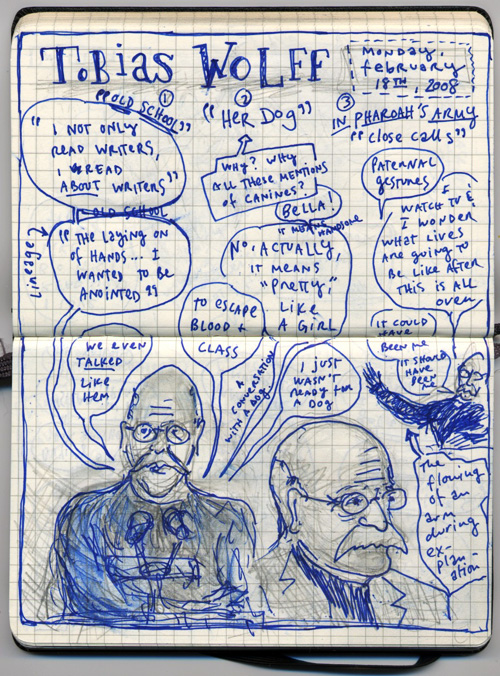
Wolff's latest collection features ten new stories, along with twenty-one oldies, and offers readers a quarter century of quality short fiction. His work, though arguably underrepresented in classrooms, remains one of the most unique and engaging examples of contemporary American fiction at its finest. Our Story Begins, like most collections, undoubtedly suffers from weak spots. Taken as a whole, however, Wolff’s stories are absolutely, and often inexplicably, both groundbreaking and transformative. All memorable writers, put simply, must approach the human condition from a perspective worth taking. That is, a perspective that reveals another small piece of the unexplored. Wolff, to be sure, accomplishes this—through technical and philosophical originality—while also giving writers and theorists a case study that demands diligent attention.
So yeah, that’s my two cents as a reviewer. As a writer, I find in Wolff’s fiction much more than this space, or my willingness, will permit me to discuss at length. I’ll confine this post to a few elements of craft and a few elements of criticism that particularly interest me, and hopefully it sets the stage for a more comprehensive conversation.

First, I want to say a few things about Wolff’s beginnings. The first few paragraphs of his stories are usually the most crucial. They provide the details of characterization that allow us to understand and interpret everything that follows. Wolff’s endings often correspond in some way to his beginnings. He often echoes, or makes us remember, something that we may have temporarily put out of our minds. These returns, I think, lend unity to Wolff’s narratives. They also provide the ammunition for the punches he delivers in so many of his stories’ last sentences.

This, on the other hand, is Tobias Funke.
The collection’s leadoff story, “In the Garden of the North American Martyrs,” provides a good example of this. Mary’s deafness is briefly mentioned in the fifth paragraph, and it nearly disappears until the last sentence when she turns off her hearing aid “so that she would not be distracted again.” This sentence resonates, not only because it illustrates the extent to which Mary’s character has grown, but also because it returns us to that which we may have forgotten. The hearing aid—a simple detail, perhaps an example of Boswell’s “narrative spandrel”—resonates for the story beyond what it might have if Wolff hadn’t deployed it early on. The reason for its resonance, I think, isn’t simply that it returns. Nor is it simply that it gives the protagonist an object upon which to act out her transformation. The crucial point here, I think, is that the object itself undergoes a transformation. No longer is the hearing aid a symbol of weakness; rather, at the end of the story, the hearing aid is a symbol of strength. Mary’s handicap, essentially, becomes her advantage. She embraces her identity, her minority status, effectively enabling herself to stand up to the majority.

The simultaneous transformation—of both an object and a character—offers one way for Wolff to achieve narrative unity and resonance. In other beginnings, Wolff doesn’t rely on a single object. In “Smorgasbord,” for instance, the protagonist introduces the general motif of food long before the prospect of dinner at a buffet arises. He also draws class distinctions between himself and his classmates, and admits his possession of an insatiable appetite, all in the second paragraph. At the end of the story, the loss of his innocence corresponds with his purchase of satiation. Desire, like hunger, can only be satisfied through the possession of the material and monetary wealth that the narrator covets. We know this from page one, but the poignancy of the consequences foreshadowed at the beginning will only hit home in the last paragraph. Essentially, Wolff subtly foreshadows cause to subtly strengthen both cause and effect. The narrator experiences a short term consequence of his subjection to the perverse indoctrination of capitalism when his relationship falls apart; on page 225, though, Wolff also hints at the long term consequences of the narrator's experience: "we recall of our own passions, as if they were no more than a series of sweet frauds we'd fooled ourselves with and then wised up to." Here, the narrator's voice suddenly speaks to us from the distant future, and yet, even this older and "wiser" narrator understands the futility of resisting the army of cultural apparatuses from which he must choose to accept either satisfaction and destruction together, as a package deal, or destruction alone.

Similarly, Wolff might introduce a character’s habit—his tragic flaw, perhaps—in the beginning of a story, which sets up its return and resonance in the end. In the fourth paragraph of “Firelight,” the narrator and his mother exercise the “power of looking” as they shop for unaffordable goods and services. This causes the narrator to worship appearances, and it results in his ultimate unhappiness at the story’s end. To really believe in something rather than its mere appearance, for him, is to “make it vanish.”

Another aspect of Wolff that I admire is his Chekhovian ability to maintain detachment and objectivity without sacrificing feeling or emotion. Wolff’s voice is never cold, nor is it sentimental. A few reasons for this, as far as I can tell: Wolff knows when to dive into a character’s head, and he knows when to stay out; he knows what information to give us, when to give it, and how; and he knows how to withhold commentary and let the action and characters (both major and minor) speak for themselves.

In “Hunters in the Snow” and “The Liar,” Woolf uses narrative detachment in two very different ways to achieve the same effect. Both stories feel distant, and both are deeply invested in their characters, but their degrees and methods of measured detachment are quite different. “Hunters in the Snow” works because Wolff stays out of his characters’ heads for most of the story. He zooms out and watches them slowly destroy each other. To hear their thoughts would be to diminish the effect of their mutual destruction. On the page, a character's thoughts lend them greater self-awareness and greater self-consciousness. If Wolff had brought it to our attention that Tub, Frank, and Kenny were aware of their individual cruelties to one another—or that they were capable of situational circumspection—then we might be more prone to pass judgment on their despicable actions. As it stands, we watch the wintry coldness of each characters' outer tragedy unfold without jumping into the warmth of their inner selves.

“The Liar,” on the other hand, demonstrates Wolff’s unparalleled ability to create perfect first person narrators. This entire story leads us, not to a transformation of the protagonist, but to the revelation of how deeply pathological he is. Rather than a turn, there is a no turning back. Like so many of Wolff’s first person narrators, the genius of the character development in “The Liar” is that the narrator’s acute unreliability is never clear enough to cause readers to give up on him. Wolff gives us just the right amount of information, such that we cannot accuse him of withholding or manipulating. He lets the narrator speak for himself, and it works because, despite his pathological lying, he is ultimately sympathetic toward his mother and utterly self-aware. The simultaneous detachment, drawn from the narrator’s objective, unsentimental recounting of the “facts,” not only makes for a fascinating character, but its juxtaposition with the narrator’s sympathy allows for the sadness of the inner story to shine through without seeming forced, manipulative, or predictable.

“The Other Miller,” my favorite story in the collection, works in a similar way. The point of view is close third person, but it feels like first person. Though some readers may anticipate the ending, this certainly does not diminish the experience of all that leads up to it. Like “The Liar,” this story is a journey into the mind of a character who understands—yet simultaneously rejects—his own situation. The slow, steady reveal of information—Miller’s relationship with his mother—juxtaposed with the action occurring on the surface—Miller’s diabolical plot to escape active duty—provides just the right amount of inner and outer story to make the ultimate revelation of the totality of Miller’s shock a powerful one. Wolff brilliantly stays out of Miller’s head unless it’s to tell us how nervous he is about getting caught impersonating himself. He also creates a convincing story by giving the two minor characters agendas of their own—they aren’t simply set pieces or devices. They drive the story because they are interesting, and their personalities and machinations distract us from the truth of Miller’s mental condition.

I think I’ve gotten long-winded, so I’ll wrap it up. I had hoped to throw some theory in—because there’s much here to be thrown—but alas, I’ll save it. One lagniappe I will add, though, is that Wolff’s stories are all immensely concerned with identity construction. Many of his characters are searching for ways to define themselves by first defining their not-selves. Crisis hits them when they run up against something that they don’t understand. Their first instinct is to fill in the blanks. If a blank clings to its vacancy, however, there arises a confrontation with the unspeakable Other. Besides its potential for theoretical musing, this also provides an interesting template for storytellers: confrontation with Otherness requires that the protagonist explain it away (fundamental misunderstanding) or become it (fundamental self-betrayal). After this choice, the protagonist fights a battle to maintain whatever sense of self in which the choice represents an investment. “Deep Kiss,” for example, follows a character’s perpetual misunderstanding of the other that ultimately results in his inability to define himself. “Desert Breakdown, 1968” follows one character who projects his dreams onto the other and thus causes his own downfall, and another character who accepts Otherness as unspeakable and thus finds the strength for self-preservation. “Next Door” also details two characters’ different approaches to explaining the inexplicable, and the last paragraph hints at the arbitrariness of all such approaches.

Anyway, I’m throwing in the towel now. All in all, amazing collection. I hope everyone enjoyed it as much as I did, and I’m looking forward to the discussion!

Hubbs out.