Wednesday, December 21, 2011

An Interview with Luke Hankins

Justin Bigos: Your first book of poems, Weak Devotions, contains a fifteen-part sequence of the same title. The sequence as well as the book contains much conversation with God, often interrogating His motives – even His very authority. What is the human cost of entering this mysterious place of devotion – as God once entered the mystery of “mortal flesh,” “his holiest act”? Is a “weak devotion” the closest we humans come to something holy?

Luke Hankins: Yehuda Amichai writes in his poem “Relativity”:

Someone told me he’s going down to Sinai
because
he wants to be alone with his God:
I warned him.

Indeed.

You ask what the human cost of entering “the mysterious place of devotion” is. In my experience, it is very high. And judging by what poets devoted to God throughout the ages have written, I think they would agree. But I don’t think anyone enters a devout life counting the cost—not even monastics and ascetics (which I certainly have never been). That’s because one can’t imagine or begin to comprehend the actual price until it’s already being exacted. Hopkins, in “Carrion Comfort,” writes:

But ah, but O thou terrible, why wouldst thou rude on me
Thy wring-world right foot rock? lay a lionlimb against me?

The psalmist(s) of Psalm 42 write(s):

Deep calls to deep
in the roar of your waterfalls;
all your waves and breakers
have swept over me.

Some, from a perspective outside of religious or spiritual devotion, would undoubtedly say that the cost is high because the devout are fooling themselves, chasing after shadows and myths and confronting their own neuroses in the dark, working themselves into a frenzy seeking what was never there to begin with. This is certainly not a novel idea for anyone who has ever genuinely sought the divine. (E.g., see R. S. Thomas’ poem “Threshold.” Whom do you meet in the desert? Is it the Maker in whom you see all of your fears and all of your hopes embodied, or is it the Nothing in which you see only a reflection of yourown inexplicable being? And which is more terrifying?

Tuesday, December 13, 2011

Sarah Vowell Gives Reading at UNT


Best-selling author Sarah Vowell visited UNT last month, entertaining hundreds of admirers with her quirky-smirky take on American history. Vowell read from her latest book, Unfamiliar Fishes, an examination of how the year 1898 (when the U.S. became an imperial power, conquering islands in the Caribbean and South Pacific) was as crucial to the formation of the American psyche as the year 1776. As with her previous books, Vowell's wry, sarcastic humor is the real story here. She enlivens seemingly dead material (the history of Hawaiian Imperialism, anyone?) with astute observations of local culture (mayonaise and soy sauce co-exist in harmony) and hilarious tangents on how mainland Americans view Hawaiian culture. But as trivial as the jokes may seem at times, Vowell is always working on a deeper level: Her interest in the U.S. conquest of Hawaii is kairotic: at one point in the book, she subtly connects a palace in Honolulu circa 1898 to another in Baghdad circa 2003. Vowell argues that despite Americans' propensity to believe that we are a nation of isolationists, unsullied by colonial pasts like other world powers, our national identity has been one of conquest for some time.

What I find so refreshing about Sarah Vowell is that she doesn't seem to get caught up in the distinction between memoir and history. Her writing aesthetic implies that history is nothing without a unique living voice to tell it and interpret it. During the Q&A, she often brought up stories from her own life to explain why she finds certain historical figures so interesting. Vowell's body of work implies that history can only be interesting if we see history as a force constantly at work in our own lives. The biographies (and autobiographies) of famous men like Teddy Roosevelt are thus entwined--in subtle, surprising ways-- with our own life stories.

Friday, December 2, 2011

Review: Space in Chains


Space, in Chains by Laura Kasischke
Copper Canyon Press, 2011
$16.00


Space, in Chains is Laura Kasischke’s eighth book of poetry, and, again, she carries us into a world that is tangible and temporal, devastating and gratifying. As I read this book, I was writing about family, illness, and being bound to place and time. I often wondered, and I’m not alone, how the everyday, the deeply personal can be translated to engage outside readers. And here is one answer—this collection of poetry speaks to the chains around us, visible or not, from the smallest molecule, to the everyday, to the unthinkable loss of a loved one. Kasischke reveals these bindings through extraordinary imagery and inspired syntactic control, knowing the exact moment to reveal or disguise, to accelerate or tap the breaks, creating poetry of poignant beauty and intoxicating truths.

Well-known for her unexpected and evocative imagery, Kasischke’s images feel natural and strange simultaneously, familiar and disturbingly unique, lingering in the reader’s head long after the poem is read. One example is the beginning of the first poem, “O elegant giant,” which reads

“And Jehovah. And Alzheimer. And a diamond of extraordinary size on the
hand of a starving child. The quiet mob in a vacant lot.”

Like in a word association game, somewhere between the conscious and subconscious, seemingly random, familiar but unconnected ideas are brought together, given new meaning, and presented to the reader. Then the reader begins to put the pieces together, reading in awe, hungry for the realization that strange does not equal imprecise, that opposites are not mutually exclusive.

The title poem, “Space in Chains,” is caught somewhere between the urge to live, the struggle to find purpose, and inevitability of death. The poem begins “Things that are beautiful, die.” And a few lines later, “Hamsters, tulips, love, giant squid. To live. I’m not endorsing it.” But the speaker is endorsing love, living, and the ties that bind because at the end of the poem she calls to her little boy whose existence creates a reason to live, “Sweetie, don’t be gone too long.” The poem asks: Is this life worth the worry and sorrow? The answer is yes. This collection speaks not only to the knots that bind us in one place, or the “knot” that is the “mind” or the love of a child but the pleasures that are created by being tethered. These poems also speak to how we grow to love the tether itself, how being bound is a kind of freedom.

So why should you read this book? If you want poetry that speaks like ghosts and haunts the outer rims of your brain and your soul—If you want poetry that is magical and agonizingly real—If you want poems that probe the dark riddles of life, poems of wholeness, fracturing and fusion—If you want poems that ask hard questions and sound like songs, if you grieve and have grieved, love and have loved, searched and are searching, you should read this book. What else can I say? Space, in Chains is a collection of beautifully controlled strangeness and musicality, a collection of large and small punches to the solarplex. Buy it today and feel for yourself.

Thursday, December 1, 2011

An Interview with Jynne Dilling Martin

Justin Bigos: I have just had the pleasure of reading the manuscript of your first book, We Mammals in Hospitable Times. The book does indeed seem to take on the larger animal experience on the planet Earth, and the voice you’ve given us is like the coolest anthropologist ever – brainy, fierce, sexual, and brimming with devilishly detailed observations and insights. Big question: what is it about poetry that provides the ideal space/form for this big mammalian brain activity?

Jynne Martin: I recently saw a portrait of the first zebra to ever arrive in England – George Stubbs painted it in 1763, and the zebra looks so confused, out of place, alone, yet watchful and curious – something burns in those big black dilated zebra eyes. This is often how I feel as I move bodily through the world – this life is so strange to me, holds so much beauty and so much sadness, and I don’t feel I am quite wired to belong here.

Something in the compactness and abruptness and weirdness possible in poetry feels like the right way to say this back to the planet. But I resonate with people saying this in any form, whether it’s Hieronymus Bosch or Chris Marker or the Log Lady from Twin Peaks.

JB: Readers will enjoy – and have enjoyed, in many magazines – your wit and humor. I laughed out loud a few times reading this book (which is rare for someone raised in Connecticut). In your poem “Beauty in Its Various Forms Appeals to You,” you describe the attempt to communicate with the “scowling stag beetle” and how even after developing a “common idiom of clicks,” “it could be months of small talk/ about hedgerows and larvae before sufficient trust was established.” The image is hilarious in part because of the tiny communication machinery you describe, but also because the poem ends so poignantly: “Clock click pause clack pause click: beloved things have been lost.” Do you find yourself drawn to a particular kind of humor? Are there certain poets you find very funny?

JM: Now you’re just trying to flatter a few bottles of Old Crow out of me – I wish I were much funnier than I am on the page. It’s so hard to be funny in poetry – we all put on our serious glasses when we sit to write or read it. IMPORTANT WORD ARRANGEMENTS HAPPENING PEOPLE FOCUS!

My favorite humor is simultaneously hysterically funny and deathly true. It exists on every page of Lydia Davis, in fragments of Stephen Crane’s Black Riders, occasional John Ashbery (especially my favorite collection Can You Hear, Bird?) and in the bodily form of Werner Herzog.

Tuesday, November 29, 2011

Review: Charles Yu's How to Live Safely in a Science Fictional Universe

“Can you live your whole life at zero? Can you live your entire life in the exact point between comfort and discomfort?”

This question lies at the core of Charles Yu’s How to Live Safely in a Science Fictional Universe. It manifests in the relations between fathers and sons, between time machine repairmen and their managers, between a time traveler and his slightly melancholy time machine, whose pixilated face is forever burned into the time machine’s display, “leaving, frozen into the screen, a kind of history, a sum total of her expressions fixed into a retained outline...the melancholy algorithm of her soul averaged and captured and recorded as a function of time.” Everyone in this novel is somehow lost, frozen in some way or another.

Yu’s novel was first published last year by Pantheon and recently received a paperback release in Random’s Vintage Contemporary line, and for a book that at its core is both hopeful and melancholy it maintains a relatively light tone. The novel is brief, weighing in at less than 250 pages, and if anything could have been much longer. But that is part of the charm. This is a tightly wound narrative, one that doesn’t linger for too long in the world that it creates.

Which is not to say that the world is obscure, that time travel is just a gimmick. It is integral to the telling of this tale. The novel could not exist without taking the metaphor literally. As the narrator travels through his own life, he travels through his memory. This is the nature of time travel here, for “every time a user recalls a memory, he is not only remembering it, but also...literally re-creating the experience.” At its heart, Yu’s novel is about the relationship between a son and a father, and the ways it has gotten off course enough that the father has literally become lost in time. Somehow, the novel manages to straddle the line between monologue and narrative. Yes, it lingers in its digressions, in its explorations of the “rules” of this universe. But if it lags, it lags only for a moment. If the momentum of the piece is hindered in the flashbacks, it is hindered only for a moment, and the lighthearted tone more than makes up for this.

Because the tone is where this work shines. For a novel that begins with an epigraph from Hume, that begins with a description of its narrator’s isolation, that is concerned with grief, regret and loss, the tone is surprisingly light. Page 27 of this text contains a huge chunk of fine print. The narrator’s manager is “an old copy of Microsoft Middle Manager 3.0” who “thinks he’s a real person” and invites the narrator for a beer even after finding out it’s only a program. The book revels in its metatextuality, but not in a way that offends the reader—the narrator has a conversation with what is essentially himself halfway through the book (which is unfortunately better when experienced than when described), and the book that becomes so integral to the plot is How to Live Safely in a Science Fictional Universe. This is experimental fiction at its best; irreverent, purposeful, tasteful and poignant all at t he same time. The combination of these traits is difficult to pull off, but somehow Yu manages it. And the success lies in his ability to jump from a conversation with that manager to a scene in which a girl uses a time machine to try to save her dying grandmother, who can’t succeed without fundamentally changing her entire life, the entire universe. It lies in Yu’s ability to weave together a narrative about a father and a son that masquerades as a pure science fiction novel that, at its core, is about a far more human issue—which is something not only the best speculative fiction does, but something that the best writing does.

Saturday, November 26, 2011

In which I am looping around to some kind of point about the holidays and being a writer

Production editor here.  I thought I’d take a minute to talk about what it means to me to be a writer while indulging in the melancholy that we’re all allowed a little bit of once the stores all start playing “Santa Baby” on a loop.
____________________________________

Thanksgiving is a tough one for me.  I like to think this is true of most writers, but then, I also like to generalize about writers in order to make myself feel better about my own troubles.  I do think a kind of emotional homelessness (or is it exile?) is a common trait of people who write fiction, given that we have a tendency to live at least one remove from the world, to have a keening need to make our lives, our arguments, our mistakes worthy of whatever it is we’ve settled on as worth, either there in the moment or after the fact when we’re trying to make meaning out of whatever stuff we’ve got to work with.  Plus we’re all kind of dissatisfied with our lives and want them to be better in ways that don’t exist.  We all want to be Gurov by the sea.

(As an almost-related aside, I was recently accused of being someone who drives a knife in just for the grace of doing it well [and even now, I’m cleaning up the accusation, making it my own], which is true enough.  I do everything that way.  It’s all performance with me, it’s all the crafting of words on a page as I go, but it’s not dishonest performance.  It’s just that the performance can get in the way.  And that’s the trouble as I saw it on my long drive back from Las Cruces today—I put the performance first.  But then I got to thinking, and I started to think that maybe it’s more about asserting my own sense of free will and identity, both of which I view as very fragile things [I’ve read theory, after all].  Which just loops back around to performance.  So.  Whatever.)

For Thanksgiving this year I went to see two of my best friends at New Mexico State.  I know I’ll always have a home with them; the trouble is it’s not my home.  The same is true of my parents’ home, of my brother and sister’s homes, of the homes of friends, of my own apartment here in Denton.  I’ve racked up a surprising amount of people who want to make me welcome, and though I don’t think they’re doing anything wrong, I rarely feel truly, you know, welcome.  When I talk to my friends about this kind of thing, they’re all quick to say “Oh, everybody loves you.”  Which is true as far as I can tell, but here’s the awful part: it’s something inside of me that keeps me from feeling it.  Doesn’t that make it worse?  Doesn’t that mean it’s something that I may never escape?  The fact is that they’re just looking through the keyhole that I’ve crafted for them into the big brown room of my brain, and so there’s always the assumption that what they love is the performance, the voice, the keyhole, and not the room behind it.  I think too much is what, I read too much DF Wallace, I linger too long on what it is to be authentic, and, in a way, I am terrified of a world in which I’m not an incessantly chattering voice.

You know where I feel welcome?  In an idea.  In a perfect sentence.  In that liminal space between thought and instinct that is going on in this very sentence right here as I’m putting it down.  Whoosh it comes and there it is.   This is what my good friend and teacher Miro Penkov meant when he said that writing poisons your life.  It’s touching the ideal, and then you’ve had it for only a second, you’ve been Gurov by the sea, and then what?

What I’ve decided you must do to mitigate this if you’ve chosen this abhorrent way to live (and it is an abhorrent way to live) is to find the people who understand as best they can and dwell among them as best you can.  The PhD program here (plus my friends in New Mexico, who are both writers as well) has provided me with that in a way that no other community has.  I’ve had conversations here that no other place I’ve been would abide.  The people in those other places would just turn up the TV if they heard me and my friends talking.  They would scoff at the way we love each other, they would say we are always either too oblique or too direct, too much bullshit or too much earnesty.  As for me, I would be nowhere else, with no other people than my fellow writers.

It will mostly be hard.  You’ll spend most of your time in your head, trapped there, maybe, which will sometimes make the community I just talked about seem incidental or barely there.  You will stay up late and wonder if what you are doing is worthwhile, which is precisely the feeling that makes you realize that it probably is.  In truth, most of you (and I am including myself in these odds) will fail in a very real, concrete way.  But we’re all going to fail.  We’re all failing right now.  Language is the very essence of failure.  And so what you must do if you’ve chosen this abhorrent way to live is to make it count: fail beautifully.

Tuesday, November 15, 2011

Dr. Fawzia Afzal-Khan on memoir


On Saturday, November 5th, Dr. Fawzia Afzal-Khan gave a reading and Q&A at UNT. Fawzia was in Denton to give a paper at UNT’s South Asia Peace Conference. She is a University Distinguished Professor of English and the Director of Women and Gender Studies at Montclair State University in New Jersey. She has published poetry, plays, and books of literary and cultural criticism. Her memoir Lahore with Love Growing up with Girlfriends, Pakistani-Style was originally published by Syracuse University Press in 2010, and received rave reviews from both magazines and notable individuals such as Nawal el Saadawi, Bapsi Sidhwa, Henry Louis Gates Jr., and Mandy Van Deven. Syracuse University Press dropped the book after a “character” threatened a lawsuit that proved inadmissible. But despite this attempted censorship—which Fawzia details on her website and in an appendix to the new edition of her book—her memoir remains in print with Insanity Ink Publications.

Fawzia’s memoir is the story of the past fifty years of Pakistan’s political, cultural, and social transformations. The book is both global and local, personal and political, and, as Carole Stone states in her introduction, it is “both a paean and rebuke to Pakistan, the country of Fawzia’s birth. It is a witness to violence against women, strictures of a patriarchal society, and narrow-minded religion, and dictorial government.” The Pakistan that Fawzia and her girlfriends inhabit is a country continually in flux, struggling to define itself in and against the increasingly homogenizing forces of globalization. The hopes, fears, triumphs, and shifting inter-relationships of this close group of female friends reveals, as Fawzia detailed in an interview, both “nostalgia for that vanished secular past and promise of Pakistan” as well as an acknowledgement of the reality of the country’s present. Yet Fawzia’s life as an international literary figure and activist diverges from the lives of her girlfriends who have remained in Pakistan, causing her to feel that she is constantly on “that rusty see-saw” remembered from childhood, a traveler both at home and abroad.

Fawzia is not the first writer to face controversy in telling the story of her life. Memoir is a genre often fraught with conflicting demands: to tell the truth, but to also acknowledge that memory can never be entirely truthful. To depict, then, these conflicting truths of memory in the most honest manner, but to also render the events of the past in a meaningful way. To give “reality” an unreal and artificial narrative structure necessarily means foregrounding some truths and letting others fall by the wayside.

In the Q&A after the lively reading which included singing, a theatrical dialogue, and “love” poetry, Fawzia discussed the role of the writer in composing memoir, stating that she was surprised and shocked that the offended character protested her depiction in the book—a depiction that Fawzia herself thought was more praise than condemnation. Many of the female characters in Lahore with Love lead lives circumscribed by oppression, struggling to exist in a patriarchal society that places little value in female narratives and voices. Madina, the offended character in what Fawzia calls “the offending chapter,” stands out for being one of the few women in the book who are able to speak without being silenced. Physically and psychologically, Madina stands out, speaks out, and carves a place for herself in the world. Controlling her public image—an image evidently upset by Fawzia’s memoir, although Fawzia told us that no one had been able to identify her character’s real-life counterpart before the scandal—seems in character with the orchestrated dramatizations that Fawzia depicts in the book. But the attempt to squelch Fawzia’s voice—her memoir—does not.

In some respects, all press is good press, and Fawzia’s memoir is now more well-known than ever. Dr. Masood Raja, a professor at UNT and editor and founder of Pakistaniaat, A Journal of Pakistan Studies, published a cluster on Lahore with Love last summer, showcasing an outpouring of support for the book. You can purchase the book directly here or on amazon.com.

Monday, November 7, 2011

An Interview with Carl Phillips

Justin Bigos: One of my favorite poems in your latest book, Double Shadow, is “The Need for Dreaming,” which you read for us last night at the University of North Texas. The poem asks the question of the usefulness of love, of beauty: “useless? It gets harder to say.” The voice, in this difficulty -- over and over, throughout the book -- finds a way past the question into maybe not an answer, but a better proposition: “I think/ to be useless doesn’t have to mean/ not somehow mattering.” The poem can be read as a defense of poetry itself, but maybe more importantly as a private struggle over the point of living. The sharing of this struggle is a profound gift. This is a huge question, but what do you hope for your readers after they put down your poetry?

Carl Phillips: Partly, I hope that a reader might see that not only is there a private struggle that each of us is going through -- just part of being alive -- but that our struggles aren't always all that different from another person's. I'd like a reader to feel that I've been able to give some sort of language to what maybe the reader has felt but not been able to articulate. Or there's also just the comfort of knowing that you aren't alone in your quest for something like purpose in a life . . .

JB: Another poem you read last night was “Fascination.” The poem ends with the image of a dying fox beneath thick brush. After reading the poem you mentioned that someone had recently asked you where such a world exists -- and you quipped, “In my backyard?” Do we sometimes forget, or not see, the natural world around us, especially in our cities? Even when not in, say, the botanical gardens of St. Louis, are you thinking of foxes, dragonflies, star magnolia, yellow-crested night heron?

CP: I guess many people do, in fact, miss the natural world for the urban one that can seem so much more overwhelming. But it's everywhere. I do live in a city, but I can catch sight of a spider's web in the light of a lamppost at night, and stand for minutes, just staring at it. For me, the natural world is all the more stunning when it surprises us where we hadn't expected it. As for me, I don't know that I'm always thinking about these things, but I'm open to them -- so, when a chicken hawk flies right overhead as I'm walking my dog, I notice it. Which is different from looking for it. I think these things are around for us to see all the time -- we don't have to be looking for them.

JB: Before the reading you mentioned the T’ang Dynasty poets, in particular Li Po and Tu Fu, as early influences. Last year in North Carolina I taught a poetry workshop themed around the parallels between ancient Chinese and Appalachian poetry, and it was amazing to see how strongly the students responded to writers like Tu Fu, Wang Wei, and Li Po. What do you think these particular poets -- even in translation -- have to offer a young writer?

CP: I think they are proof that poetry can be powerful simply by being clear, straightforward, elemental. Because of the clarity, those poems seem to speak with an immediacy that feels very contemporary, which is to say, it immediately includes us as readers. There's also an intimacy to the poems, that also includes us. I return to the T'ang poets almost every night before going to bed -- what's strange about the apparent simplicity is that the poems seem to deliver something new each time . . . For young writers, I think the appeal is that poetry, in the hands of Li Po, Wang Wei, and Tu Fu, seems approachable, not just because of the clarity, but also because so much of it is about being human and flawed: getting drunk, being sad, missing a friend. When I was first shown poetry in school, it was nothing like this -- everything seemed to require translation, even from English, into something I could understand. It made poetry seem intimidating from the start.

JB: It meant so much to have you here with us in Denton. Thank you.

CP: Thank you, Justin -- I had a wonderful visit.

Carl Phillips is the author of eleven books of poetry, including Double Shadow, currently a finalist for the National Book Award. He is a Professor of English and African and African-American Studies at Washington University in St. Louis.

Monday, October 31, 2011

ALR Reading Series Excerpts

Shout outs to our wonderful readers, Young George for the wonderful photos, and Simone Lounge for hosting us yet again.


Poetry by Chelsea Wagenaar
"Matins"

This morning’s matins are dream-based, fear-infused,
a first groggy plea not to still be waiting tables,
not to have my teeth break off and spew out of my mouth,
not to be coiled and bound on a precipice, awaiting
the promised superhero. He’s probably been detained—
perhaps stumbling heat-ravaged through the furnace
of lower Texas, or on a South American vacation,
unable to turn his eyes from the glaciers of Patagonia,
cerulean and windswept, terrible. The city of ice
reminds him of another, a city of glass towers
they’d called it, which he’d swooped in to rescue
from gangs and mafias, only to find all the ornithologists
wandering the streets stunned, mute, gathering
the stilled bodies of white-throated sparrows
from the sidewalks. Their shattered anatomies.
A whistle trapped in each throat, the world
that much quieter.
                         Cold coffee this abandoned morning,
straggling rain, thumbed out sun. Vagrant tongue,
I’ve followed you here, your far-fetched horizons,
your tall tales. Too often you return empty.
O Lord, there are even elegies for the guilted sidewalks,
small laments that throb to be heard, so what
is your reply? Word made feather. Made glacier.
Made flesh—that your eyes are fixed here,
your ears lashed and ragged with the tatters of prayers.


Nonfiction by Courtney Craggett
from "The First Day"

We were travelers, all of us running, running either from or toward – running from a bad economy, family obligations that had become too heavy, religions that were no longer our own; running toward love, adventure, cheaper master’s degrees, cultural enlightenment. And there we found ourselves, bound together in a new culture, in a new language, trying to make sense of everything and find our place in a world that was suddenly much larger than it had ever been before.

There was Caitlin from Boston, never afraid to speak her mind and at first a shock to my Texas-drenched sensibilities. There was Kristin, who said she came to Mexico and felt like she’d found her true nationality. There was Sarah. She wore a brand new engagement ring and was planning for her wedding next summer. There were Cynthia and Nikki, both from Mexico and the US, neither one exactly sure of where she belonged, so both of them here for now. There were others, too – Shannon and Angela and Claritza and Caro and Sebastian. I didn’t know any of them then, but in the year ahead I’d go wedding dress shopping with them, watch three of them get married, attend baby showers for another three, help one down the stairs when she sprained her knee, road trip to Acapulco with a few others, bake cupcakes, make dinners, celebrate holidays, watch movies. But all of that came later.

The air was sharp on that first morning. Back in Texas my family was gearing up for another 105-degree day, but down here, two hours south of Mexico City, the mountains had snow on them and the wind raised goose bumps on my arms. Although my roommate Kay and I had been to the high school a few times, we’d never taken the bus. Up until now school administration had driven us around. Como podemos llegar a La Paz, we asked a few men on the corner of the 31. “How do we get to La Paz?”


Poetry by Mark Wagenaar
excerpt coming soon!

Thursday, October 27, 2011

An Interview with Rose McLarney

Justin Bigos: Rose, there are many things to admire in your forthcoming, first book of poems, The Always Broken Plates of Mountains. The book contains voices, and yet I sense a voice; stories, and yet I sense a story. You have a poem titled “Ars Poetica,” and another titled “Poet,”but there are many poems in this collection that could stand for the whole, the way a leaf of a fern looks like a fern. It’s a big question, but can you talk a bit about how you see these poems speaking to each other? And how did that help you arrange them into the pages of a book?

Rose McLarney: These are my ambitions for The Always Broken Plates of Mountains: A cast of speakers, like a chorus, express the thoughts of people who share a rural background and landscape. The landscape is more than the physical setting in the Appalachian mountains—it’s an atmosphere created by weaving together stories of both personal and larger cultural loss. The poems are not only about romantic love, but perhaps more significantly, about faithfulness to place. Though the perspective in this sequence varies, the poems are united by a characteristic voice. The voices are alike in that they are understated and musical, with tendencies to defer and deflect, as were the voices around me as I grew up. The voices are also united because they speak of love and loss, experiences that are so utterly un-unique that perhaps the only way they can be interesting is to use them as points of commonality.

At least that’s what I hope happens in the book. A significant time for me as a writer was a morning when I was shuffling through my many poems and began to think that they weren’t necessarily redundant because they addressed the same themes, or necessarily at odds because their speakers were different, but that they could work together. Now, reading and writing poems in series and sequences is a kind of acknowledgment that, though poetry can look so concise and definitive, you can’t express a thing well enough all that quickly or easily. Or I can’t. Sequences give me a chance to make the admission that I may never articulate what I want to completely, yet show my continuing best efforts.

Of course, while series allow me to try out different iterations of an idea, they are also limiting. A number of the poems I write just wouldn’t fit in this book. (For instance, some of my greatest pleasures are rather exotic cooking and experimental music and those subjects have no home in The Always Broken Plates of Mountains.) I’m well into working on my second book and, for it, I am trying to write distinctly different poems about another country, another continent, from another point of view, and there will be poems that won’t find company in this collection either.

In answer to your question about how the poems are arranged in the book, they are grouped by and progress through an arc of tones (though nothing as neat as a plot triangle). My intention was for the book to feel as if it resolved—even if the resolution at which it arrives is a message about disappearing, keeping quiet, being still. (Those may be some of the predominant messages I got from mountain culture. I don’t want to romanticize it. Of course, that instruction in humility may have also prepared me to inhabit personas.)

Tuesday, October 18, 2011

Jaimy Gordon and the polyvocal world of Lord of Misrule

Award-winning author Jaimy Gordon visited UNT last Tuesday. In her Q&A with students and faculty, she described her writing as simultaneously "all about voice" and tightly plotted and carefully structured. She described the writing process as one which uses imagination to create or locate narrative in the raw material of the observable world. This creation comes though on the page via a "massaging" of language, sometimes using "a voice that's trying to replace the real world with its idiosyncratic output" in a technique that Gordon calls "heightened first person." Gordon also stressed grounding a story in the literal world and creating a plot that unfolds towards a central event that connects all of the characters. The story, she said, should function on two levels: a surface story that contains a deeper undertow or undercurrent of thematic depth. Although she draws from folktales, fairy tales, opera, and a host of writers stretching from present day to the seventeenth century, Gordon keeps her own writing in Lord of Misrule, winner of the 2010 National Book Award, solidly planted in the universe of its racetrack setting.

Author Andrei Codrescu, one of the fiction judges for the 2010 National Book Award, states that Jaimy Gordon has "an incredible command of other voices, and a sense of music in language that is unequaled.” Lord of Misrule is praised as “moving and lyrical,” possessing prose that is “moody, poetic, darkly funny,” with language that is “so textured that her pages seem three-dimensional.” In the world of Lord of Misrule, racetrack slang mingles with gangster dialect and the ingredients for “horse goofer dust,” a magical concoction that guarantees a horse to win—but also results in that horse’s destruction. A polyvocal novel, each section of Lord of Misrule shows us another facet of the world of horse racing: owners and trainers, groomers and jockeys, gangster financiers and, of course, the horses themselves, who speak though their intricately described gestures on and off the track. 

Lord of Misrule
is also a page-turner, masterfully constructed of unexpected reversals of fortune. And as Jaimy Gordon states in an interview with Bret Anthony Johnston, she “believes deeply in plot, or rather in whatever attribute it is of novels that makes a reader need to know what happens in the end.” Horse racing presents an obvious arc: who will win? And in the hands of a lesser writer, a horse race’s outcome might be the central question of the book. But by the time we get to the arrival of the Lord of Misrule, the titular horse, we’ve already been through three races, and a kidnapping, and watched as each voice, gesture, and description, using language high and low, spirals around a tightly constructed core. The Lord of Misrule appears in the final section of the novel, a demon horse brought in to run a fixed race. The melee of Gordon’s close-third perspectives unites to watch him arrive in third person plural: “They were all looking for a van like a Chinese jewel box.” In this van— a vehicle in fact disappointingly ordinary—is the horse, who possesses a head that is “calm, black and poisonous of mien as a slag pile in a coal yard. He had a funny white stripe like a question mark on his forehead.” The horse’s arrival is big news, “they looked at each other and they thought, this is big, and how can we get a piece of it, we’ll take anything, even a hoof paring, sawdust, loose change.” But The Lord of Misrule could care less about their adoration, providing a stark contrast between the stuff of dreams and the more mundane ingredients of hard realities. Upon arriving at the run-down Indian Mound Downs, he throws back this same head and “snorted out dust and rolled his eye at the other cheap horses. His black tail arched and, ugly as Rumpelstiltskin, he let drop great soft nuggets, part gold, part straw, all the way down the ramp.”

Please join us on Thursday, November 3rd for our next visiting writer, poet Carl Phillips, who will participate in a Q&A in LANG 314 at 4 pm and give a reading in the Golden Eagle Suite of the University Union at 8 pm. Phillips' most recent book, Double Shadow (FSG 2011) was just named a finalist for the 2011 National Book Award in poetry.

Monday, October 17, 2011

Hey, here's some stuff I read

I think it's important in a literary landscape that seems sometimes obsessed with its own image as ever-dwindling and unnecessary to talk about and celebrate the success stories.  Here's one: Can Harper Perennial Reinvent Publishing

And if you're a fan of David Foster Wallace, Mary Karr, Jeffrey Eugenides, or Jonathan Franzen, or if you are the kind of person for whom lit. gossip is a weird kind of catnip, then you owe it to yourself to read this: Just Kids.

And... that's it.  I'm sure Laura will be by later to be a much better blogger than I.

Tuesday, October 11, 2011

Phillip Lopate on the Genre of Creative Non-Fiction

Last Wednesday, prolific author Phillip Lopate visited the University of North Texas. He gave a reading and participated in a Q&A with students. Lopate is one of the giants of CNF, editing the anthology The Art of the Personal Essay (Doubleday-Anchor, 1994), which is a required tome in all nonfiction classes. He is equally at home in the genres of fiction and poetry; his three most recent books are Two Marriages (novellas, Other Press, 2008), the nonfiction book Notes on Sontag (Princeton University Press, 2009), and At the End of the Day: Selected Poems (Marsh Hawk Press, 2010). Despite, or perhaps because of, his facility in "writing across genres," Lopate defended CNF as a distinct genre with its own rules and quirks, although arguably one that lacks the kinds of systematized studies or theories that unpack fiction and poetry. Although CNF is older than most give it credit for, it is often viewed as the younger, less sophisticated (though maybe more fun!) sibling of fiction and poetry. Fake memoirs! Real memoirs about trashy subjects! Fake memoirs about trashy reality stars!

Lopate offered an interesting insight about the state of CNF today, namely that it faces pressure to be "more like fiction, " containing dialogue, scenes, and action. He urged against inserting short-story-esque "epiphanies" or the more formal structures of poetry into the CNF form, allowing instead for an essay to follow an "interesting consciousness" as it tries to make sense of the world. In this sense, CNF brings the personal into the writing process, dramatizing the very nature of being and bringing writing back to the point were it was said to veer away from authorial intent.

But when I taught UNT's multi-genre introductory level creative writing class last spring, this fictionalization and depersonalization of experience is exactly how the multi-genre textbook that I used (Heather Sellers' The Practice of Creative Writing) instructed one to transition between CNF and fiction. Tell your students, it said, to place the events of their life into a narrative arc. Lopate didn't say to dispense with narrative arcs altogether (he did say that an essay must contain a sense that we are "getting somewhere"), but above this he championed the meditation on life, what he termed the "drama of consciousness" or thinking itself "enacted" on the page. It's a bold approach that invigorates "telling," that venerates an "amoeba-like structure," and that allows for a new kind of writing process: "working something out on the page that translates into excitement for the reader." CNF, Lopate argues, can combine the "character and story" of fiction with the "leaping from thought to thought" characteristic of poetry. But the result of this combination is a genre of writing all its own, a new way of communicating with the world and a new method for puzzling through the tensions of existence.

Please join us this afternoon (10/11) for a Q&A with our next visting writer, Jaimy Gordon, at 4 pm in room 317 of the Language building. Jaimy will also be reading tonight at 8 pm in the Golden Eagle Suite inside the University Union.

Monday, October 10, 2011

An Interview with Laurie Saurborn Young

Justin Bigos: First, congratulations on getting your first book, Carnavoria, accepted by H_NGM_N BKS. What was your experience of sending out your MS, and how did you decide to send to H_NGM_N?

Laurie Saurborn Young: Thanks very much, Justin. It was a long slog and a learning experience. I sent it out to well over 150 small-press contests and open reading periods since I graduated from Warren Wilson in 2008. I never got the guts up to query bigger publishers like Copper Canyon or Graywolf. The more I worked with the manuscript, the more it became my own. I was constantly writing and adding and subtracting poems—I learned more firmly that poems and manuscripts are not static entities; that I’ll be making changes until the editor rips it from my hands. And the work became stranger. It’s not conventional, and at times I truly despaired of ever finding an interested audience. Though I got a couple of nibbles early on, as I continued adding new poems and removing others, the nibbles disappeared.

Once I referred to this phase (of not having a book out) as “limbo.” This was at a dinner here in Austin for the poet Harvey Hix, who taught at UT in the Spring of 2010. As I recall it, he said, “That’s a nice way of putting it. It’s more like hell.” A couple more rounds of sending it out into the Vacuum of No Reply and I changed my “limbo” to his “hell.”

Ultimately what I think was most valuable was that I became more certain of my own voice, more confident of my approach. It also taught me how to persevere, and made me certain both of myself as a poet and of my poems. When the rejections came in, I didn’t say, “Oh my God, how can I change this so someone will like it?” There is no way to predict which editor or committee or guest reader will like whose work, so that’s a non-productive, exhaustive line of thinking. Poetry is not about pleasing people (and this is a southerner talking). For me, it’s about finding readers and listeners interested in what the poems are saying—or what they interpret the poems as saying (something over which the poet has little, if any, control).

When Nate Pritts, editor of H_NGM_N BKS and fellow WW alum called me this past spring and asked if the manuscript was still available, I was absolutely thrilled. A couple of weeks earlier I read Matt Hart’s Wolf Face and Alexis Orgera’s How Like Foreign Objects. Honestly, H_NGM_N was the place I truly wanted to be published—but I didn’t hold out any particular hopes, given my pile of rejections. I love the books H_NGM_N publishes, and am extremely thankful to be included in their line up. But then I started right in on my second manuscript. Now it’s out in the world for the time being and I’m working on a third. I like hard deadlines, and I like sending out a manuscript and not knowing what will happen. Hope and feathers, as Dickinson would say. Reading Viktor Frankl’s Man’s Search for Meaning at an early age definitely helped motivate me, though it took a while for me to build up my confidence. Time passes whether I write or not. I’ve decided I’d rather it pass while I’m engaged in this productive, invigorating, challenging art.

Monday, October 3, 2011

Insideout

by M. Sweeney

John stands shaving at the morning mirror, sunlight burning a molten oval in the frosted glass at his side. He slaps too heavy with the razor, distracted, ruing the inexplicable erosion of closeness with his girlfriend, Jeannie, of late. It escapes any logical analysis. None of it should be happening. Yet all of it is happening. He might as well wish his whiskers would grow back in again.

Some odd shuffle in the sunlight and a massive double take–they WERE growing in again. Surely that’s an illusion? No! Each hair stiffening out to right angles, creaking in its follicle, then slipping back into it like spaghetti sucked between lips.

What the blue murdering…?

Then, absurdly he hears the tune, the Finnegan tune, playing in his mind, but too loud, as if echoing in a bucket. It’s playing on a violin, a manic violin…someone sitting on the pan behind the door fiddling away like a lunatic. He boots the door. Nothing.

He went fishing with a pinnegan.

His hands shake as he holds the razor. “Not happening. None of it happening.” The hairs draw back from the razor, every one of them, burrowing under his skin. He tries to brush his teeth but he keeps losing track, has to start over. Begin again. The sun burning in the window.


He grew fat and then grew thin again.

He escapes the bathroom, fear clutching at his windpipe, decides to phone Jeannie. His ear burns from too much sunlight. Or is it the receiver? It seems like he’s called her already. Perhaps many times. His heart lurches, edge of panic. She’s already speaking.

“Yeah, who is it?”

“It’s me Michael. Michael Finnegan.” He stares at the mouthpiece in horror. He didn’t mean to say that. It just sort of…

Crackle on the line. “John? Honey?”

He tries to speak but never gets started. But always gets started. And is already finished.

Then he died and had to begin again,

“John, you don’t sound so good, I’m coming home.”

He tries to reply.

*Click.*

But the words are good. Goood words. There’s hope in the words. Real sunlight, not like the bathroom.

She arrives at the door. It’s still there but fading. Life is returning with her.

“The bathroom” he bleats, pathetically, touches his face. “Just there, round the side, my chin, chinnegan.” Tears press but don’t emerge.

She takes his face in her hands. “John, honey, are you ok?”

Something about her touch grounds him, a lightning rod. He sucks a deep breath.

“Yes…yes. There was something, It came out. But it’s in again now.. In again for good.” Breathing easy now, clearly now. “Look, just promise me we won’t lose track of each other again.”

Friday, September 30, 2011

Book Review Friday


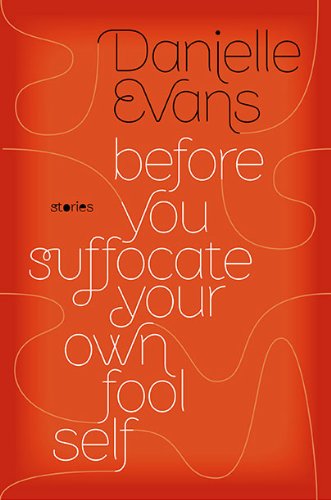
Before You Suffocate Your Own Fool Self

by Danielle Evans
Riverhead, 240 pp., 2010
Reviewed by Jessica Hindman

“Me and Jasmine and Michael were hanging out at Mr. Thompson’s pool” (1). So begins “Virgins,” the first story in Danielle Evans’s Before You Suffocate Your Own Fool Self, a brilliant debut collection that showcases Evan’s stunning ability to unearth racial and sexual complexities with deceptively casual language. In this first sentence, Evans creates a setting that could not seem more blasé: three teenagers “hanging out” by a pool. But under the surface of suburban normalcy, racial and sexual dangers lurk. As the story progresses, we find out that the seemingly simple act of lounging by Mr. Thompson’s pool is in fact a result of complex racial, sexual, and class hierarchies:

Mr. Thompson was retired, but he used to be our elementary school principal, which is how he was the only person in Mount Vernon we knew with a swimming pool in his backyard. We—and everybody else we knew—lived on the south side, where it was mostly apartment buildings, and if you had a house, you were lucky if your backyard was big enough for a plastic kiddie pool. (6)

In other words, Mr. Thompson is offering a favor to the lower-class narrator—Erica—and her friends. And despite their young age, Erica and Jasmine are already wary of male favors:

“We hung out with [Michael] because we figured it was easier to have a boy around than not to…When you were alone, men were always wanting something from you. We even wondered about Mr. Thompson sometimes, or at least we never went swimming at his house without Michael with us.” (6)

Evans is so subtle in establishing the dangers that surround her characters that the reader barely notices as she slowly raises the stakes. When the three teens decide to use their fake IDs to go clubbing in New York City, the danger seems more of the suburban variety (getting caught by their parents) than the late-night-news variety (rape or murder). But as the story progresses, the two types of dangers—the urban and the suburban—become increasingly conflated. At the end of “Virgins,” neither Erica nor Jasmine is still a virgin, but Erica has lost her virginity in a familiar suburban setting, while Jasmine has disappeared to have sex with strangers in the Bronx. The move from the suburban to urban and back, however, is ultimately inconsequential; neither of the girls has encountered sex in a safe, premeditated, or fulfilling way. Here Evans demonstrates the absurdity of presuming that the suburbs offer black teenagers a safer alternative to the city. The girls’ parents are working so many shifts (presumably to afford a suburban existence) that they fail to notice their daughters’ transgressions. And even though no one in the story says so directly, we know implicitly that the sexual stakes for white girls in this suburb are much lower than they are for Crystal and Jasmine.

Indeed, Evans’s writing is at its strongest when she shows how typical suburban high jinks swiftly become more ominous when the characters in question are minorities. The story, “Robert E. Lee Is Dead,” follows the relationship between Geena—a popular cheerleader who gets kicked off the squad for low grades—and her friend Crystal, who has managed to become valedictorian despite the school’s racial prejudice. When Geena asks Crystal to participate in a senior prank, Crystal points out that “White kids do senior pranks. When we try it, they’re called felonies” (220). Crystal ends up participating in the prank anyway, but when the prank gets out of hand and the two girls accidentally set the school football field on fire, Geena insists on taking the blame. The last image of the story is of Crystal running from the scene of the crime:

“I stared at Geena for a long second. Then I took off running, stopping in the middle of the parking lot to take off my heels. I kept running, the asphalt stinging my feet through my panty hose. Halfway up the hill behind the school, I stopped to look back, vaguely recalling Sunday school and Lot’s wife turning into a pillar of salt. Already I could hear sirens in the distance. I watched Geena sitting on the curb beside the pay phone, fists curled backward into cushions for her chin. She looked small and still and ready. I turned then, shut my eyes, and ran breathlessly toward the dam. I didn’t stop again until I had crossed the bridge and hopped the fence that took me back to Eastdale. On the other side, I stopped to catch my breath, and then kept running, knowing even then that a better person would have turned around.” (229)

At the core of this story, and the entire collection, is a moral question: How can blacks who have attained academic and worldly success live in a world where too many black teenagers literally get left behind on a curb? Evans prose here is stunning in its ability to show the pain of separation that occurs in the suburbs when upwardly mobile black youth leave their less fortunate friends to deal with the all-too-familiar consequences of racial inequality. Indeed, the title of the collection comes from a Donna Kate Rushin poem, which Evans includes as an epigraph to the book. In the poem, Rushin writes, “I’m sick of mediating with your worst self/On behalf of your better selves.” Evans’s stories are masterful portraits of characters who want to become their “better selves,” but who, for many reasons—racism, sexism, guilt about the others who are left behind while they enjoy newfound success—are never quite satisfied with their progress.

Monday, September 26, 2011

Flash Monday

A Sleeve Made of Hearts

by Zach VandeZande

Her job in those days kept her downtown pretty late, so I got to wandering around out of doors. It started out as sitting on the porch with a beer or two, looking the way a stray animal might, some possum or unwanted cat. The house, it was too big for me to be in it alone, I kept checking for intruders or ghosts, and anyway she was the one who wanted to move out here to the suburbs.

And eventually, yeah, I started walking around, and I started knocking on a few doors, got to asking questions and pretending like I was taking the census. A neighbor would open her door and I would say Excuse me, but do you think that love is just the selfish need to have your jokes laughed at, your bed shared, to have someone know as much as they can of you and still say Okay, yes, I want you to hold on tightly, and I will do the same? Answer on a scale of one to five. Five being strongly agree. So what if I’d had a drink or two? I’d still be professional, I’d still lean in all serious with my pen and my clipboard and wait patiently for them to consider the question. And I’d listen, really listen, to what they had to say.

In this way we got to know each other, the neighbors and me. But she found out about it and got mad, asked me to knock it off. I quoted Walt Whitman back at her—I’d been reading Walt Whitman on the porch sometimes. We secretly thought each other snobs. Different kinds of snobs, but still, it was a rough time.

Suburbs, they’ve got a breaking point to them, and it comes from within, it comes from the dull edge of shame in each resident. That’s the whole point of a homeowner’s association, to keep the chaos out, to keep that awful feeling of shame away. Also black people, probably, depending on the neighborhood. So what if they got involved? So what if I got citations in my mailbox? Quelling the human heart isn’t a noble thing was my thinking. So when she threw in with them, yeah, I took it kinda personal. So maybe my survey questions became a little hostile, maybe I threw up some whiskey on Miss Applebaum’s rose bush, maybe I lit a lawn or two on fire. The point is, and I’m marking it five on a scale of five, the point is I did it in defense of love.

Sunday, September 25, 2011

We Drank Until We Fell Over

Thanks to Simone Lounge for hosting the first ALR Graduate-Student Reading of the semester, and to Cool Beans for hosting the after-party. At least two of us have bruises and no memory of how they were received.


Poetry by Kara Dorris
Excerpt from My Highway of Sure Things


Yesterday, I found the lizards
behind my house doing it again.
“An offense to justice” honoring
a hydrangea bush I killed
last summer with a happy love.

On the back porch in hunter green
plastic containers, full of
Miracle Grow & shame,
sit open-mouth replacements.

Of course for the ground’s sake,
for the sad goldfish I buried underneath
in the toxic memory of bedazzle beads,
I wanted to wait a full year to announce
recovery, to absorb the French fry bits
& salt & blackberry fingers I used
to kill Fish.

But the lizards only have eyes
for each other & don’t believe in stories
with tragic heroes or closing actions.


Fiction by Laura Miller
Excerpt from "Perspective"

My appointment was on the first floor, room 109. The door wasn’t closed, so I stepped inside. It was a recycled space, used by traveling artists, private instructors, psychotherapists. Light from one undressed window freckled the podium and the whiskey bottle beside it. In the corner, a woman perched atop a yoga ball rattled the ice in her Styrofoam cup. She stood and extended a bony hand.

“I’m Dolly,” she said, wobbling a little in her heels. She grabbed my hand and pumped it hard before stepping behind the podium. “Let’s get started, shall we?” Dolly squinted through her rimless frames, tortoise-shell detail on the temple. “Usually we do this with two people,” she said. “But whatever gets your ghost.”

“No, actually,” I said and stepped closer to the podium so not to raise my voice. “I just have a few questions.”

Dolly slouched a little and reached toward me. She curled a lock of my hair around her manicured finger. “Aren’t you a sweet little thing,” she said and released the tress. “Go for it, honey pie.”

I pulled out a notebook from my coat pocket and tried not to notice as Dolly rolled her eyes. “For starters, your credentials…”

Dolly tapped the whiskey bottle with the tip of her purple heel. She puckered her lips as if slurping the answer from the air. Her fingers curled around the edge of the podium. “Pumpkin face, let me tell you about my credentials. My grandfather is an alcoholic. My brother shoots meth in his arm. My mother has been schizophrenic for 10 years. And my ex-husband works on Wall Street. I know a thing or two about dealing with assholes.”

“I see,” I said and knew immediately that it was the wrong thing to say. Dolly stepped out from behind the podium and teetered toward me like some prehistoric bird. She bent at her waist to meet me eye-level.

“Lover, what’s your name?”

“Bella,” I told her, reeling from the finger that moved toward my jaw line.

“Bella, I’m a busy woman. I run sixteen of these joints. Thirty-two people work under me, and I have twelve more appointments today. You want to tell me why you’re here?”

“Well, I came with my mother, but I just don’t understand what exactly it is that you do,” I said and plunged my hand in my coat pocket. My fingernails found the crystal and scratched at its surface.

Dolly stood upright and looked down at me. Her glasses slipped to the end of her nose. “I’ll tell you exactly what I do, sugar plum. I give perspective. People come to me because someone in their life has a twisted point of view. Sometimes people can’t see what’s right in front of them. You get me, Bella? It might be a close friend, a coworker, a boss. Most often, though, it’s a family member. How about that mother of yours. Could she use some perspective?”


Poetry by Nate Logan
Excerpt from "Booty Call Sonnet #32" (for Adam)

Where is the discussion of booty
in the Environmental Prose class?
We're out here pretending
to be graduate students in botany,
while booty flies in the lights
above Tucson. Orange blossoms
get busy in the boats of our nasal canals—
how can we care about plants
at a time like this? The weekend
before the assignment is due,
I'll write about the miles of cacti
and the dry heat. But tonight.
Tonight is not too hot for love.
Tonight is right for dry humping.