Showing posts with label Book Club. Show all posts

Friday, July 1, 2011

How Reading Lorrie Moore’s Self-Help Is Like Swimming in a Public Pool

I read at swimming pools. And because I’m borderline schizophrenic, I sometimes have trouble differentiating between fictional narratives and reality. Or maybe that’s just one of the many neuroses that accompanies writerhood. Potentially both are true. I read Lorrie Moore’s Self-Help poolside, and I watched the characters walk off the page and into swimming trunks and Spongebob floaties.

There was the wife watching her husband oogle the girl in too-small bikini.

There was the mother clipping a leash to her 13-year-old child.

There was the grandmother coating her leathery skin in coconut oil.

Mostly women, mostly in relationships, and mostly enacting self-destructive behaviors, these pool dwellers made it easy for me to draw swooping parallels. They laughed. The loved. They made ridiculous mistakes. In short, they lived. Like these people, Lorrie Moore’s characters are heartbreakingly honest.

You could work with the woman catering an affair with a married man.

You could babysit the 12-year-old girl exploiting her parents’ divorce for 7up.

You could have lunch with the mother, wife, and cancer victim who commits suicide.

But Lorrie Moore does more than offer you a glimpse into their lives. It’s not only voyeurism that makes these stories so satisfying. It’s not just that you watch their struggles and learn from their mistakes. It’s that you become these characters.

Since the dawn of the creative writing workshop, much has been said about the second-person narrative. Mostly in the form of, don’t do it. It’s gimmicky. It’s confrontational. You can’t pull it off. On the flip side, if you do pull it off, it creates urgency and snap, like a green bean begging to be eaten. The reader and story fuse.

At the swimming pool, as in these stories, I was not just watching the people around me. I was keenly aware of myself as part of the scene. I played a role in the narrative, and was, in fact, that girl in too-small bikini (it's probably time I buy a new one). I swam with them, sometimes barely keeping my head above water. I played with their children. I sunburned.

Lorrie Moore doesn’t offer a ten-step guide to beating depression or reveal the secret to driving your dream car. Instead, she gives us experiences that closely mimic her own. The characters aren’t helping themselves. More often than not they end up fired or dead or in a mental institution. But ironically, I still felt helped.

Because Lorrie Moore is an artist.

She can describe a bleeding wound, and we at once feel pity for the victim and awe for the scribe. We’re marveled by her ability to spin scabs into golden stories, and because we’re human too, we feel as though we may be capable of some such level of greatness.

Despite the strong emotional connection, the collection does indeed have some flaws. The drug-induced haze at the end of “Go Like This” falls flat. The men in the collection are intrusively one-dimensional. The stabbing in “To Fill” doesn’t behoove the character.

Yet, in many ways, these flaws make the collection even more endearing. Reading authors like Chekhov and Steinbeck can wear you down. No matter how hard I try, I will never write their stories. Our experiences are too dissimilar. Lorrie Moore is an accessible writer and watching her experiment on the page excites my imagination, much like watching a swimmer try a new dive. You may end up with a few sore spots, or even a head wound, but that doesn’t keep you from jumping off the diving board.

Thursday, July 1, 2010

ALR Summer Book Club: Bret Anthony Johnston’s Corpus Christi


Misconceptions underlie many of the stories in Bret Anthony Johnston’s collection Corpus Christi. As Minnie herself tells us: “there was no one time when she missed Richard the most—a misconception of those who’d never lost a spouse…She wasn’t angry at him for dying—a misconception of therapists; she was angry she’d survived”(38). Characters often go through a change wherein they realize that their initial view of themselves, others, and the world around them is out of sync with the reality of their situations. In each of his masterful stories, Johnston gives us a sliding scale of perception and misperception, and seems to always know just when to hit us with the truth. As he says in an interview at the close of the collection: “one of the things I’ve tried to explore…might well be called the myth of memory…If our memories play a large part in defining us, what happens if those memories are wrong or are no longer accessible?”(264). He wrote the book, he says, to imagine what these situations might be like.

We see Johnston’s interest in exploring the way that the world and our interactions with it can define us from the very first story, “Waterwalkers,” where, as in many of these stories, a character struggles to put himself together after some manner of devastating loss: “those mundane encounters left him utterly unsure of his identity. No longer a father, no longer a husband”(12). As Sam hides himself away from the world that can no longer figure out how to define the new him—after the tragic death of a son and the subsequent loss of a wife—we can see the power that lies in the way that our past defines us not only for ourselves, but in the eyes of others as well.

As the Sam searches for meaning in all of what’s happened to him, he draws the predicted routes of hurricanes on a large map. Of course, as his ex-wife Nora points out, he’s wrong about the direction that that hurricane will take, but he’s correct in that hurricanes (or, acts of chance or fate) frame the deciding events of his life (meeting Nora, his son Max dying, finding Nora again). The parallel between the precise nature of hurricane in one aspect (produced by exact combinations of the forces of nature) and the random chaos and destruction that they cause is heartbreaking when applied to Sam’s life. We don’t fault him, or ourselves, for trying to map some meaning onto the forces of chance.

Many of Johnston’s stories contain this element of chance meeting: “Outside the Toy Store” and the mash-up at the end of “Corpus Christi” are other examples. Rarely do the characters get what they expect out of these chance encounters; what at first seems like a hopeful coincidence often serves to make the relationship worse off than it was in the first place (as “Outside the Toy Store” depicts a particularly brutal way).

Equally heartbreaking are the repeated mentions of luck in the first story of the three-story cycle of Minnie and her son, Lee, “I See Something You Don’t See.” Only a few pages in we learn that Minnie’s luck has once again run out, resulting in Lee thinking(incorrectly) that only he knows the truth about his mother’s condition. In keeping the truth from her, Lee sees himself as finally refuting the accusation that he is a man “unable to accept kindness”(48).

But as the story cycle as a whole demonstrates over and over again, there are often vital differences between the way that characters see themselves and the way that others see them. Far from being heavy-handed with this message, however, Johnston draws our attention to this fact lightly with the moment that spawns the title of the story itself, as Minnie recalls the rules of the game I see something you don’t see(52). The premise of this game, of course, is to get the other person to uncover what was always already there. The fresh perspective spurred by requesting, literally, that the other look at the world in a different way seems to be the only thing that can keep at bay the myriad number of misconceptions that keep piling up all around. The visual knowledge that we can gain by looking at the world differently comes to us through a verbal clue. Like the layers of meaning in the stories themselves, it is up to the listener to find their own path to the object in question.

The keystone moment, as Miro would say, for the “myth of memory” occurs in the third story, “Buy for Me the Rain,” when Moira says “‘everything happens to me twice,’” and Lee replies, “things rarely happen to me, even once’”(231). Lee’s description of himself, of course, is not true. We see Lee repeat the actions of his father over and over again, from soothing Minnie in that first emergency room visit, to duplicating the way Richard spoke to her, “she saw him gauging what would be best to say, what would be worst. Richard had done this”(58), to similarities in his appearance and motives “He resembled his father, his thin hair and sloped shoulders and even his reticence as he checked the cupboards” (160). Lee repeats his childhood actions as well “as in his youth, he still cut food with a fork rather than a knife”(142), and we never forget that the two are re-enacting, with a dark difference, their roles as mother and son. Minnie eventually forgets Lee’s name in her dementia, but never who he is: “through that long, excruciating fade, there always remained a silky, durable cord of memory that connected them, a child and his mother”(161).

The conclusion Moira come to in this moment, “‘so we’re a good fit’”(231), about the relationship between her and Lee is as untrue as it’s even been. Unlike his mother, Lee knows that “[Moira] would not grow to need him”(231). As a result, like Sam, everything feels “random and unmoored”(238) in the wake of Minnie’s death. The repeated experience of sneaking off with Moira “relived and vexed him”(242), because he expects that Moira will make his life different, more exciting, but also more uncomfortable, the repetition of an encounter whose meaning he has never understood in the first place. Unlike Minnie, Moira withholds the clues that Lee needs to see her clearer. This, of course, is what draws him to her. In contrast, we have some of Lee’s final actions as his mother has slipped into a coma “he took one of the crazy straws that she liked and returned to the den. He smiled in case she could see”(247). And then the Chekhovian realization, as he lies in bed with Moira, that the events of the funeral and that night are “only the beginning”(252). The worst of his troubles, left without someone from whom to withhold a comforting voice in the night, are yet to come.

There are many other themes worth exploring in this collection. “In the Tall Grass,” “Two Liars,” and “Birds of Paradise” (and, in a way, “Anything That Floats”) all depict coming-of-age stories wherein the young protagonists learn a little more about the adult world than they’d maybe like to. Johnston says “what I find inherently interesting about the parent-child relationship is its fragility and its durability”(265).

There’s also this tantalizing quote, from an interview at the close of the collection. Johnston says, answering a question about the violent weather in Corpus Christi, “…and of course there’s no controlling [the weather]. When these characters find themselves in violent or intimate situations, they’re often stripped down to their essences [….] Violence and intimacy, or love, require participants to leave themselves unprotected, to take chances, to gamble with the worst odds for the highest stakes”(264).

But, that’s for someone else to tackle, I’ve bloviated long enough. Looking forward to seeing what everyone has to say, I hope you all enjoyed this collection as much as I did!

-Hillary

Wednesday, June 23, 2010

ALR Summer Book Club: Jhumpa Lahiri’s Interpreter of Maladies

Jhumpa Lahiri’s Pulitzer-Prize-winning short story collection Interpreter of Maladies (1999) is our highlight this week at the ALR blog. Fans of Lahiri’s first published story collection will also want to read her novel The Namesake (2003) and her most recent publication of short stories, Unaccustomed Earth (2008) to follow her map of questions about self and family. A story is a series of sentences, one after another, but it does not follow that perfect sentences make a perfect story. While the smooth, minimalist sentences of Interpreter of Maladies can feel unemotional, the stories gather a pathos that will certainly move readers. Her exploration of the Indian-American experience, especially the effect of immigration on the different generations, provides a study of human nature that transcends age, gender, and nationality: everyone hopes and everyone grieves. The nine stories in this collection model for writers the truth that there is no more compelling subject than human relationships.

In an interview with The Atlantic, Lahiri says that she likes her prose to be plain. She continues: “Even now in my own work, I just want to get it less—get it plainer. When I rework things I try to get it as simple as I can. … My writing tends not to expand but to contract.” The following quote from the title story “Interpreter of Maladies” can be taken as evidence of her success, though plainness and simplicity by no means exclude elegance or emotion. Mr. Kapasi, a tour guide, fantasizes about having a relationship with Mrs. Das, an Indian-American whose family is taking a tour in his cab, and her request for his address to send him some pictures makes him hopeful:

The paper curled as Mr. Kapasi wrote his address in clear, careful letters. … As his mind raced, Mr. Kapasi experienced a mild and pleasant shock. It was similar to a feeling he used to experience long ago when, after months of translating with the aid of a dictionary, he would finally read a passage from a French novel, or an Italian sonnet, and understand the words, one after another, unencumbered by his own efforts. In those moments Mr. Kapasi used to believe that all was right with the world, that all struggles were rewarded, that all of life’s mistakes made sense in the end. The promise that he would hear from Mrs. Das now filled him with the same belief. (56)
This is as smooth as language can get. Mr. Kapasi’s memory of the act of translation, a thematically significant trope, beautifully parallels his trust that he will hear from Mrs. Das again. At first it seems as simple as saying, “This is like that,” but coupled with the fact that Mr. Kapasi no longer remembers several of the languages he once knew, his naiveté here ought to warn him and does warn us readers that all struggles are not rewarded, and that some things will never make sense. By use of simple words, clear verbs, and little decoration, Lahiri describes the dear self-deception that is the source of much of Mr. Kapasi’s behavior.

My favorite story is “A Temporary Matter,” the first in the arrangement. One of the most perfectly constructed stories I have ever read, it describes the slow disintegration of Shukumar and Shoba’s marriage a few months after the stillborn delivery of their first child. That information is delivered on page three with as much sterility as one would find in a hospital: “When he [Shukumar] returned to Boston it was over. The baby had been born dead.” The story’s title is apparent in the first sentence, when the couple receives a notice that due to winter storms, their electricity will be temporarily turned off for one hour every evening for five days. During the outage, over dinner, Shoba initiates a game in which they each tell the other a secret, from a harmless lie to an unfaithful impulse. But the temporary matter gradually becomes, of course, their marriage, and the two secrets that Shukumar and Shoba tell each other at the end of their game are shocking symbols of their grief.

About the symmetry of the narrative structure of “A Temporary Matter,” Shoba and Shukumar are progressing equally on opposite paths, a perfect X. As she spends more time away from the house at her work or the gym, distancing herself from the painful memories and unfulfilled hopes, Shukumar spends more time at home, sometimes not leaving the house for days. In fact, purposefully to avoid Shoba, he moves his desk into the baby’s room, though he does little work on his dissertation. Another reversal is the shopping and cooking, which Shoba had taken great pleasure in, foresightedly buying and preserving food she thought was in excess of their needs, and which she now leaves to Shukumar, who has discovered for himself the small pleasure she left there in the remains of the carefully labeled rice. Dinnertime in the candlelight has become the one time of day when the couple meet to spend time together, but if things continue as they have begun, the routines Shukumar and Shoba have invented for themselves will cease to intersect.

Lahiri’s characterization of the story’s two principle characters—the others are all peripheral, occurring only in Shukumar’s memory except the Bradfords, themselves a picture of what the husband and wife will never be—is built on a slowly amassed pile of significant details. Shukumar’s first description of Shoba has her just home from the gym with the remains of her makeup darkening her eyes, but on the fifth day he reports, “She hadn’t been to the gym tonight. She wore a suit beneath the raincoat. Her makeup had been retouched recently” (20). This litany of facts assumes significance in light of the last confession Shoba makes at dinner, that she will be moving into an apartment. She is ready to make complete her distance from him, absenting herself completely from the house she treats “as if it were a hotel” (6). At first Shukumar interprets her appearance as a return to normalcy, to their previous intimacy, but after she breaks the news it becomes a sign that Shoba has begun planning for the future again, yet one that does not include him.

The notion of the lights going out is a significant metaphor, one of the few that Lahiri indulges herself in. The act of confession becomes easier for the couple in the dark; on the first night Shukumar moves the impromptu candle holder farther down the table, “making it even more difficult for them to see each other” (11). As they communicate more freely and for the first time in months, Shukumar begins looking forward to the evening, thinking all day about what he will say to his wife upon her return from work. He takes more care with the food and himself, even leaving the house to buy candles to facilitate their nightly game. On the fifth day, however, the electricity has been repaired early, and their truth-telling must occur in the light. After Shoba tells him she is leaving him, Shukumar tells her against her wishes “the one thing in her life that she had wanted to be a surprise” (22), the gender of their child, a boy. After these confessions have been received in silence, Shoba turns off the light, and they sit together at the table, crying. In the darkness they become more enlightened, hiding their wounds from the harsh light of day.

Shoba tells Shukumar, “You didn’t have to tell me why you did it” (18), which could be the words of the author herself. Lahiri practices an eloquent restraint from commenting on the morality, decisions, behaviors, or emotions of her characters. Shukumar is drowning in grief, but Lahiri never once mentions the word. Her sentences, clinically correct, only imply the emotional states of the man and woman who did not become parents; even when they cry, she observes the fact like a reporter. Did you find Lahiri’s narrative style appropriate or comforting? Singly, each of these stories carries the lonely reservation of characters walking over strange and foreign ground, missing communications and suffering grief; but together in a collection, that burden might become commonplace through too much familiar treatment. What did you think about “A Temporary Matter” and about the eight other stories? Did you find them too different or too similar? What was your experience reading Interpreter of Maladies?

If you love Jhumpa Lahiri, visit her website or listen to her read and discuss William Trevor’s story “A Day.” If you want to talk more about Interepreter of Maladies, take a look at the reading group guide from Houghton Mifflin or leave a comment.

Thursday, June 3, 2010

ALR Summer Book Club: Our Story Begins

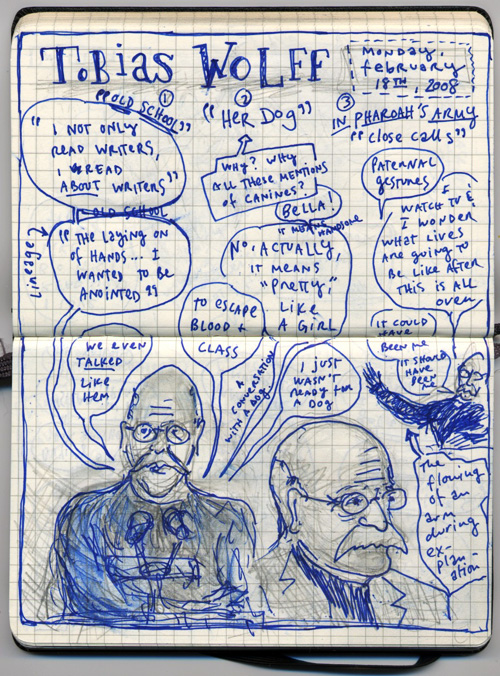
Wolff's latest collection features ten new stories, along with twenty-one oldies, and offers readers a quarter century of quality short fiction. His work, though arguably underrepresented in classrooms, remains one of the most unique and engaging examples of contemporary American fiction at its finest. Our Story Begins, like most collections, undoubtedly suffers from weak spots. Taken as a whole, however, Wolff’s stories are absolutely, and often inexplicably, both groundbreaking and transformative. All memorable writers, put simply, must approach the human condition from a perspective worth taking. That is, a perspective that reveals another small piece of the unexplored. Wolff, to be sure, accomplishes this—through technical and philosophical originality—while also giving writers and theorists a case study that demands diligent attention.
So yeah, that’s my two cents as a reviewer. As a writer, I find in Wolff’s fiction much more than this space, or my willingness, will permit me to discuss at length. I’ll confine this post to a few elements of craft and a few elements of criticism that particularly interest me, and hopefully it sets the stage for a more comprehensive conversation.

First, I want to say a few things about Wolff’s beginnings. The first few paragraphs of his stories are usually the most crucial. They provide the details of characterization that allow us to understand and interpret everything that follows. Wolff’s endings often correspond in some way to his beginnings. He often echoes, or makes us remember, something that we may have temporarily put out of our minds. These returns, I think, lend unity to Wolff’s narratives. They also provide the ammunition for the punches he delivers in so many of his stories’ last sentences.

This, on the other hand, is Tobias Funke.
The collection’s leadoff story, “In the Garden of the North American Martyrs,” provides a good example of this. Mary’s deafness is briefly mentioned in the fifth paragraph, and it nearly disappears until the last sentence when she turns off her hearing aid “so that she would not be distracted again.” This sentence resonates, not only because it illustrates the extent to which Mary’s character has grown, but also because it returns us to that which we may have forgotten. The hearing aid—a simple detail, perhaps an example of Boswell’s “narrative spandrel”—resonates for the story beyond what it might have if Wolff hadn’t deployed it early on. The reason for its resonance, I think, isn’t simply that it returns. Nor is it simply that it gives the protagonist an object upon which to act out her transformation. The crucial point here, I think, is that the object itself undergoes a transformation. No longer is the hearing aid a symbol of weakness; rather, at the end of the story, the hearing aid is a symbol of strength. Mary’s handicap, essentially, becomes her advantage. She embraces her identity, her minority status, effectively enabling herself to stand up to the majority.

The simultaneous transformation—of both an object and a character—offers one way for Wolff to achieve narrative unity and resonance. In other beginnings, Wolff doesn’t rely on a single object. In “Smorgasbord,” for instance, the protagonist introduces the general motif of food long before the prospect of dinner at a buffet arises. He also draws class distinctions between himself and his classmates, and admits his possession of an insatiable appetite, all in the second paragraph. At the end of the story, the loss of his innocence corresponds with his purchase of satiation. Desire, like hunger, can only be satisfied through the possession of the material and monetary wealth that the narrator covets. We know this from page one, but the poignancy of the consequences foreshadowed at the beginning will only hit home in the last paragraph. Essentially, Wolff subtly foreshadows cause to subtly strengthen both cause and effect. The narrator experiences a short term consequence of his subjection to the perverse indoctrination of capitalism when his relationship falls apart; on page 225, though, Wolff also hints at the long term consequences of the narrator's experience: "we recall of our own passions, as if they were no more than a series of sweet frauds we'd fooled ourselves with and then wised up to." Here, the narrator's voice suddenly speaks to us from the distant future, and yet, even this older and "wiser" narrator understands the futility of resisting the army of cultural apparatuses from which he must choose to accept either satisfaction and destruction together, as a package deal, or destruction alone.

Similarly, Wolff might introduce a character’s habit—his tragic flaw, perhaps—in the beginning of a story, which sets up its return and resonance in the end. In the fourth paragraph of “Firelight,” the narrator and his mother exercise the “power of looking” as they shop for unaffordable goods and services. This causes the narrator to worship appearances, and it results in his ultimate unhappiness at the story’s end. To really believe in something rather than its mere appearance, for him, is to “make it vanish.”

Another aspect of Wolff that I admire is his Chekhovian ability to maintain detachment and objectivity without sacrificing feeling or emotion. Wolff’s voice is never cold, nor is it sentimental. A few reasons for this, as far as I can tell: Wolff knows when to dive into a character’s head, and he knows when to stay out; he knows what information to give us, when to give it, and how; and he knows how to withhold commentary and let the action and characters (both major and minor) speak for themselves.

In “Hunters in the Snow” and “The Liar,” Woolf uses narrative detachment in two very different ways to achieve the same effect. Both stories feel distant, and both are deeply invested in their characters, but their degrees and methods of measured detachment are quite different. “Hunters in the Snow” works because Wolff stays out of his characters’ heads for most of the story. He zooms out and watches them slowly destroy each other. To hear their thoughts would be to diminish the effect of their mutual destruction. On the page, a character's thoughts lend them greater self-awareness and greater self-consciousness. If Wolff had brought it to our attention that Tub, Frank, and Kenny were aware of their individual cruelties to one another—or that they were capable of situational circumspection—then we might be more prone to pass judgment on their despicable actions. As it stands, we watch the wintry coldness of each characters' outer tragedy unfold without jumping into the warmth of their inner selves.

“The Liar,” on the other hand, demonstrates Wolff’s unparalleled ability to create perfect first person narrators. This entire story leads us, not to a transformation of the protagonist, but to the revelation of how deeply pathological he is. Rather than a turn, there is a no turning back. Like so many of Wolff’s first person narrators, the genius of the character development in “The Liar” is that the narrator’s acute unreliability is never clear enough to cause readers to give up on him. Wolff gives us just the right amount of information, such that we cannot accuse him of withholding or manipulating. He lets the narrator speak for himself, and it works because, despite his pathological lying, he is ultimately sympathetic toward his mother and utterly self-aware. The simultaneous detachment, drawn from the narrator’s objective, unsentimental recounting of the “facts,” not only makes for a fascinating character, but its juxtaposition with the narrator’s sympathy allows for the sadness of the inner story to shine through without seeming forced, manipulative, or predictable.

“The Other Miller,” my favorite story in the collection, works in a similar way. The point of view is close third person, but it feels like first person. Though some readers may anticipate the ending, this certainly does not diminish the experience of all that leads up to it. Like “The Liar,” this story is a journey into the mind of a character who understands—yet simultaneously rejects—his own situation. The slow, steady reveal of information—Miller’s relationship with his mother—juxtaposed with the action occurring on the surface—Miller’s diabolical plot to escape active duty—provides just the right amount of inner and outer story to make the ultimate revelation of the totality of Miller’s shock a powerful one. Wolff brilliantly stays out of Miller’s head unless it’s to tell us how nervous he is about getting caught impersonating himself. He also creates a convincing story by giving the two minor characters agendas of their own—they aren’t simply set pieces or devices. They drive the story because they are interesting, and their personalities and machinations distract us from the truth of Miller’s mental condition.

I think I’ve gotten long-winded, so I’ll wrap it up. I had hoped to throw some theory in—because there’s much here to be thrown—but alas, I’ll save it. One lagniappe I will add, though, is that Wolff’s stories are all immensely concerned with identity construction. Many of his characters are searching for ways to define themselves by first defining their not-selves. Crisis hits them when they run up against something that they don’t understand. Their first instinct is to fill in the blanks. If a blank clings to its vacancy, however, there arises a confrontation with the unspeakable Other. Besides its potential for theoretical musing, this also provides an interesting template for storytellers: confrontation with Otherness requires that the protagonist explain it away (fundamental misunderstanding) or become it (fundamental self-betrayal). After this choice, the protagonist fights a battle to maintain whatever sense of self in which the choice represents an investment. “Deep Kiss,” for example, follows a character’s perpetual misunderstanding of the other that ultimately results in his inability to define himself. “Desert Breakdown, 1968” follows one character who projects his dreams onto the other and thus causes his own downfall, and another character who accepts Otherness as unspeakable and thus finds the strength for self-preservation. “Next Door” also details two characters’ different approaches to explaining the inexplicable, and the last paragraph hints at the arbitrariness of all such approaches.

Anyway, I’m throwing in the towel now. All in all, amazing collection. I hope everyone enjoyed it as much as I did, and I’m looking forward to the discussion!

Hubbs out.