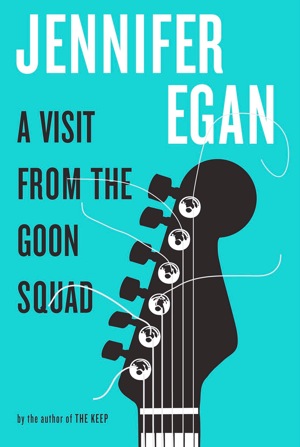
So let me begin by stating that I disagree with everything that’s been written about Egan, even by The A.V. Club—not only is Goon Squad not great, it’s not even good. The novel presents us with a string of flat characters based on clichéd types (a rich, middle aged record executive who feels like a sellout; a woman who steals because she has yet to deal with her traumatic past; a teenage girl who thinks it’s cool to party with an older man, then looks back on her life with regret).
The lack of character development is a direct result of the novel’s gimmicky structure; gimmicky because rather than providing multiple perspectives on the central characters—how do the sections about Dolly or Jules Jones enhance or complicate our understanding of Sasha and Bennie, for example?—or exploring a theme that can only be understood through the experiences of multiple characters—the primary themes of the novel are "compromise" and "regret," which each character experiences in the exact same way: everyone compromises on their dreams or ideals or artistic intentions; and everyone regrets that compromise—Goon Squad's structure serves only to build artificial momentum, pulling the reader along with the promise of a new character and style to discover in the next chapter.
Which brings us to the variations in style. There are subtle shifts between the narrative tone used for Sasha (ch. 1) and Bennie (ch. 2). Then there are the pronounced stylistic shifts into second person (ch. 10), absurdist imitation (ch. 9), idiomatic minimalism (ch. 3), first-person unreliable (ch. 6), and image rich travel writing (ch. 11). And then there are chapters that veer into the familiar territory of great fiction past: the over the top social satire of, say, Tom Wolfe (ch. 8); the Hemingway-esque African safari that reveals the unacknowledged cracks in a relationship (ch. 4); the quiet desperation of a husband and wife in the suburbs that evokes the likes of Cheever or Richard Yates (ch. 7). The critics have praised Egan’s virtuosity, but in reality the author has merely produced an amalgamation of the techniques and voices forged by her predecessors, which she then packages as innovative fiction. But there is nothing innovative about Goon Squad.
The only chapter that could rightfully be called inventive—the power point presentation—is a flop. This narrative device serves no purpose, diminishes the affect of the information it conveys, and stretches our willing suspension of disbelief (a twelve-year-old girl expresses the distress she feels about her family by creating a sophisticated presentation about the subtle tension between her mother, father, and brother? What did she do after that, create a flow chart to plan a conversation with her parents about buying tickets to a Justin Bieber concert?). By botching this chapter, Egan leaves us with a dissatisfying conclusion to the arc of Sasha, one of the two characters that hold everything together. Of course, the laughable final chapter—even the positive reviews have criticized Egan’s lazy, distopian take on the near future—compounds the dissatisfaction. Bennie, the other recurrent character, is equally forgotten in his final appearance in the novel. These clumsy final chapters only succeed in emphasizing that Goon Squad is not a grand epic about the destructive passage of time, but a series of low impact stories that rely on a loose (and ultimately meaningless) level of association to build a semblance of significance.
One final note: Egan’s decision to quote Proust in her epigraph not only signaled her intention to place Goon Squad in conversation with In Search of Lost Time, it also gave readers instruction on how she intended the novel to be approached. A bold move. Obviously, I think the association is ludicrous. For an excellent example of a Proustian reflection on the U.S. in the second half of the twentieth century, read Philip Roth’s American Pastoral (the 1998 Pulitzer Prize winner). Also, just read Swann’s Way.